

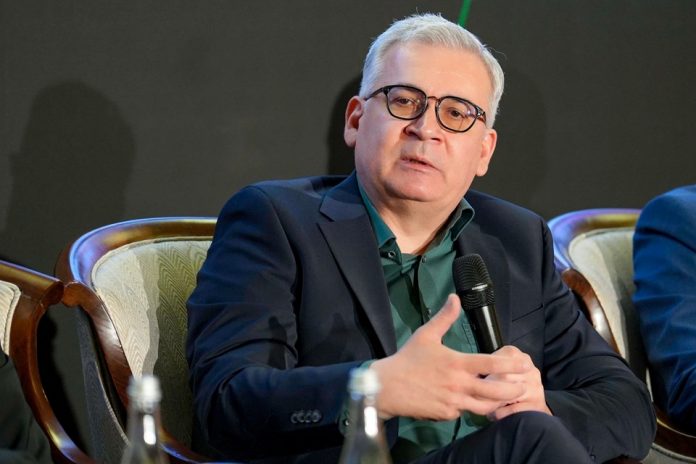
Romania has emerged as a model of best practices in the circular economy, with its deposit-return system standing as a central pillar of this success, according to Radu Pascu, Commercial Manager at RetuRO SGR.
“At the stage we are now—close to maturity—with strong results, collection rates exceeding 83% last year, and a very large number of collected packages, over 9 billion and approaching 10 billion at present, along with an enormous quantity of material brought back into the market—over 700,000 tonnes so far—we can say that a key factor for us has been a highly coherent, well-structured, predictable, and clear legislative framework,” Pascu said during Circular Economy Conference organized by The Diplomat-Bucharest and Sustainability Today. “This legislative framework was not easy to build or clarify, but it has given us the strength to act effectively in the market.”
Key statements
- “The commitment from producers and authorities has been crucial. Equally important were the efforts made by retailers to establish collection points and continuously adapt them as the system evolved and increasing numbers of consumers returned growing volumes of materials.”
- “Support from Romania’s recycling market has also been essential, helping absorb increasing quantities quickly and consistently as we scaled up.”
- “A strong team capable of aligning producers, retailers, authorities, and consumers played a major role. The consumer incentive was also critical—it is a key element for the system’s proper functioning and performance. Without such an incentive, the system simply cannot work.”
- “Beyond delivering tangible results and data that can guide the evolution of the collection system—including the potential introduction of new types of packaging—the deposit-return system has enabled us to produce high-quality material.”
- “This has been consistently improved through the technologies applied in our facilities and ongoing upgrades, ensuring that the material we supply to recyclers is of superior quality, with very few impurities, sorted into fractions. This allows recyclers to operate more efficiently and produce material that is easier to sell and reuse in new packaging.”
- “We believe clearer legislative definitions are needed regarding ‘bottle-to-bottle’ recycling and how it should be applied. While our efforts are primarily focused on bottle-to-bottle, we do not restrict access to other applications within the system.”
- “PET is becoming an extremely important material in Europe. Global developments strongly influence this sector, particularly PET and aluminum. Aluminum, in particular, is experiencing rapid growth in both cost and demand from recyclers and processors.”
- “We do not yet have very large quantities of aluminum. Romania still has lower per capita consumption of aluminum cans compared to neighboring countries, but we are seeing growth this year despite economic pressures affecting consumers.”
- “It is crucial to have recycling centers located as close as possible to our operations. Proximity is extremely important. We also need strong packaging producers, well distributed geographically, as this significantly impacts the entire system.”