

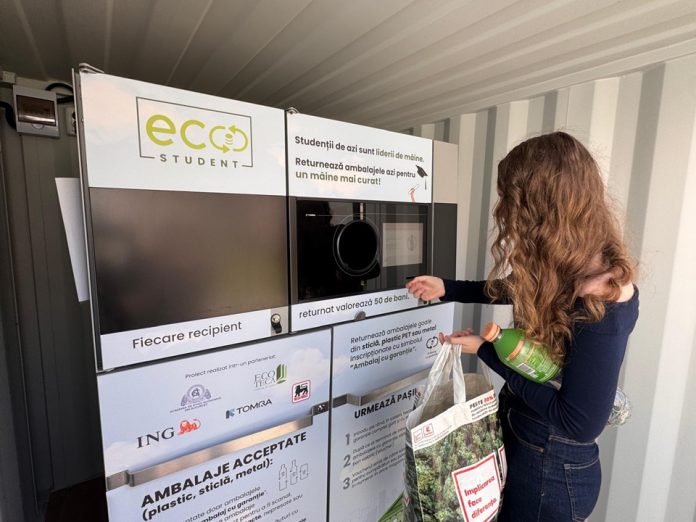
Students at the nine universities where the ECO Student programme is implemented returned 502,789 beverage containers during the 2025–2026 academic year through the ten automated collection systems installed on university campuses. The project is run by the ECOTECA Association in partnership with ING Bank Romania and TOMRA Collection Romania.
Plastic packaging accounted for the largest share, with 297,605 units, or 59.2% of the total, followed by metal packaging, with 145,339 units, or 28.9%, and glass packaging, with 59,845 units, or 11.9%.
Together, plastic and metal packaging represented 88.1% of all containers collected through the ECO Student infrastructure during the academic year analysed.
Proximity: the factor that turns intention into actual returns
The results recorded on university campuses are consistent with a favourable national context. The 2025 Every Can Counts Global Survey, conducted among more than 16,000 participants across 16 countries, including 1,013 respondents in Romania, shows that nine out of ten Romanians participate in the Deposit Return System (DRS), while 77% support the system. Romania is therefore among the countries where adoption has progressed most rapidly.
The intention to recycle is already there, but infrastructure plays an important role in turning that intention into action. According to the survey, 41% of Romanians say that a faster return process would encourage them to return more packaging, while 38% point to the need for collection points that are closer or easier to access.
“The results from the 2025–2026 academic year show that collection infrastructure works when it is located in places where students spend their time every day. More than half a million containers collected represent a significant volume recovered through the Deposit Return System, but also demonstrate that such solutions can become part of everyday life on university campuses. For us, the next step is to continue expanding ECO Student while maintaining the education and direct student engagement component,” said Petra Șerbănescu, Project Manager, ECOTECA Association.
On a university campus, where students’ daily routes repeatedly connect dormitories, classrooms and cafeterias, placing collection points close to these frequently used locations reduces the time and distance required to return packaging.
“ECO Student provides a highly relevant picture of how young people interact with the Deposit Return System when automated collection solutions are available to them. The more than 500,000 containers returned by students in a single academic year represent not only a significant volume of packaging recovered, but also evidence that the younger generation responds positively when collection solutions are accessible and easy to use. At TOMRA, we believe that technology and infrastructure should be as close as possible to consumers, and university campuses are an excellent environment for turning participation in the circular economy into an everyday habit,” said Dorin Miha, General Manager, TOMRA Collection Romania.
ECO Student network expanded with seven new return points
During the 2025–2026 academic year, the ECO Student network expanded with seven new automated packaging collection systems installed on the campuses of seven universities.
The new return points were opened at the University of Agronomic Sciences and Veterinary Medicine of Bucharest, University of Oradea, National University of Music Bucharest, Technical University of Civil Engineering Bucharest, “Lucian Blaga” University of Sibiu, “Grigore T. Popa” University of Medicine and Pharmacy in Iași, and the Bucharest University of Economic Studies, at the Moxa Campus.
“We set out to contribute to the development of Romania’s Deposit Return System through a range of initiatives. We know that this is truly a national project that supports the economy, environmental objectives and the community alike. We started by providing bank financing for the infrastructure and for RetuRO, the company operating the system nationally. Initiatives such as ECO Student naturally complement this effort by providing education and bringing return points closer to student communities. The results after two years of the project show us that when infrastructure is accessible and well integrated into the spaces people use every day, engagement comes naturally. Whether we are talking about students or consumers in general, people are more willing to get involved when solutions are simple and readily available,” said Alexandra Ranetti, Sustainability Manager, ING Romania.
Infrastructure Backed by Education
Throughout the academic year, the infrastructure component was complemented by student-focused activations, workshops and information campaigns covering the Deposit Return System, separate waste collection and the circular economy.
In some cases, individual participation was particularly significant. At the University of Oradea, for example, a single student returned 1,600 containers through the Deposit Return System.
With a consolidated network and a growing body of data that now provides a benchmark, ECO Student enters the new academic year with the objective of further expanding its collection infrastructure while maintaining the educational component accompanying each collection point.