

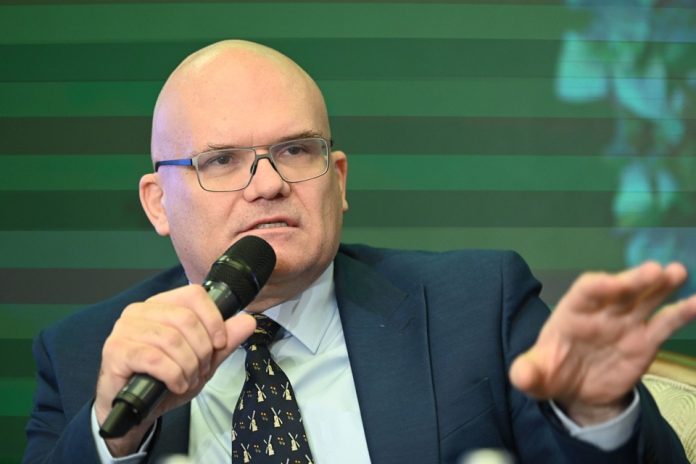
Romania can draw important lessons from existing Extended Producer Responsibility (EPR) schemes and from the Deposit Return System (DRS) when designing a system for textile waste management, Raul Pop, Honorary Adviser to the Ministry of Environment, said at the “Circular textiles. Less waste, more future” conference.
Pop pointed to the experience accumulated through the implementation of EPR systems in Romania, where producers can operate through different organizational models, as well as the country’s Deposit Return System.
“We have already seen Extended Producer Responsibility systems being implemented, and we have seen different models operating in recent years. We have, in a way, the two options side by side: one in which producers can choose between several organizational systems, and the other, which is a regulated monopoly, namely the Deposit Return System,” Pop said.
He argued that both models can provide valuable lessons for the future organization of textile EPR.
“I believe we can learn a lot from there — principles of operation, implementation mistakes, options that work and so on,” he said.
Pop stressed, however, that the public administration faces significant capacity constraints and competing priorities, which are slowing down regulatory developments in the textile sector.
“The Ministry of Environment is buried under a lot of priorities,” he said, adding that pressure comes both from the European Union towards Romania and from developments on the ground towards local and central authorities, particularly in areas such as enforcement and regulation.
As a result, progress on establishing a comprehensive framework for producer responsibility for textiles has been slow, according to Pop. He also noted that developments at European level have been relatively gradual.
At the same time, he said, several pilot initiatives and “test systems” emerging across Europe could provide useful evidence on what works and what does not.
“I think that is also the fastest recommendation, or the easiest-to-understand recommendation, that I could make to the entities or individuals active in the field of proper textile management: look at these attempts and learn from them,” Pop said.
Pop also warned that the textile industry has yet to fully take ownership of the issue of managing textiles throughout their entire life cycle.
“The proper management of textiles throughout their entire life cycle is something that, in my opinion, the industry has not yet taken ownership of,” he said.
He acknowledged that individual companies may already be taking steps but argued that the broader industry — including companies operating from outside Romania and even from thousands of kilometres away — needs to be represented in the dialogue.
He identified this as one of the main risks for the future system: ensuring that the emerging framework is sufficiently representative and capable of addressing different types of market participants.
“One of the first risks that needs to be managed is the representativeness of what is being consolidated as a system, so that it also captures these types of exceptions,” Pop said.
A second major risk, according to Pop, is the capacity to work effectively with public authorities.
He linked this challenge directly to the regulatory timetable, saying that Romania had failed to make significant progress over the past year and that the current political context did not suggest a decisive push for major reforms in the near future.
“We haven’t managed to make significant steps in the past year, and, especially looking at the political context, I don’t see a drive, I don’t see a decisive movement to revolutionize the sector in the foreseeable future,” he said.
Pop nevertheless welcomed what he described as improving cooperation between the Ministry of Environment and the Ministry of Economy, noting that the two institutions have increasingly worked together on regulations and enforcement.
He said similar cooperation should extend to consumer protection authorities in areas where textiles have a significant impact on consumers.
“Just as, at least theoretically, the control institutions of the Ministry of Environment work with the National Consumer Protection Authority on single-use plastics, they should also work together in other areas, such as textiles, where there is significant consumer exposure,” Pop said.
He emphasized that determining the boundary between waste and a product — including reused or reusable products — requires the involvement of all relevant state institutions.
“When you talk about a dividing line between waste and a product, even if that product is reused or reusable, it is absolutely essential to include in the discussion the responsibilities of all state institutions that are relevant to that particular field,” he said.
Concluding on an optimistic note, Pop stressed that the transition to a circular textiles system will require sustained cooperation between public institutions and the private sector.
“These things cannot work in isolation. All state institutions, as well as the business environment, need to collaborate, and they need to do it out of a genuine interest,” he said.
For businesses, he argued that economic incentives should be at the core of the system rather than simply the desire to avoid penalties.
“The principle of operating based on the fear of fines will only push things into irrelevance and towards chasing the lowest possible costs, without ensuring the medium-term sustainability of such a system,” Pop said.
He also urged companies to consider the capacity of public institutions to respond effectively as a factor of risk and to plan their engagement with authorities accordingly.