

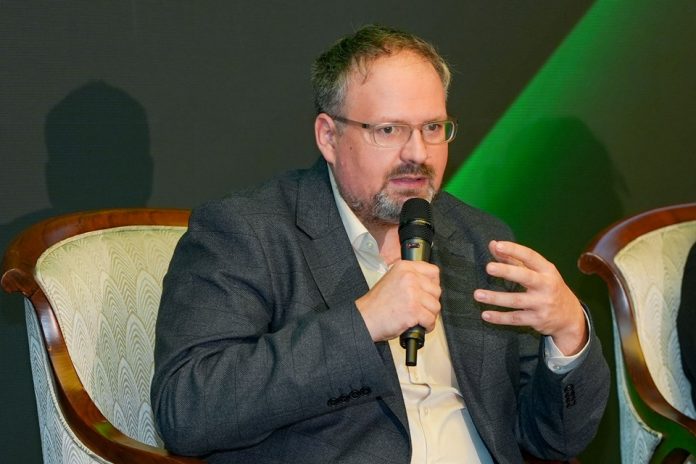
Romania needs to move beyond simply supporting production capacity and focus on innovation, developing products with higher added value and strengthening domestic market demand, Dan Adrian Pop, State Secretary at the Ministry of Economy, said during the Sustainability in Business Forum, organised by Sustainability Today and The Diplomat-Bucharest.
“Strictly supporting production capacity is no longer a solution that could be sustainable in the future. If we fail to expand our market, educate it and find customers to whom we can offer innovative products with added value, we will not be able to build a sustainable economic model,” Pop said.
He explained that the Ministry of Economy is working both on financing mechanisms and on shifting the priorities of the departments responsible for developing and implementing support programmes, with innovation playing a central role in the approach.
According to Pop, Romania has significant potential across several sectors, including IT, steelmaking, construction and tourism. However, he argued that the country needs to do more to promote businesses capable of becoming recognised national champions in their respective industries.
“In Romania, we very much like to boast about the idea that we can do everything. We say we are good at everything, from IT to steelmaking, construction and tourism, but we are not succeeding in promoting and pushing forward those champions that could truly make Romania stand out,” he said.
Pop also highlighted the importance of shared values in shaping Romania’s international economic relationships, particularly as foreign countries increasingly seek business opportunities in Romania due to its access to the European Single Market.
“As a country that is part of the European area, we want to do business, but especially with those who share common values with us,” Pop said.
He noted that the Ministry of Economy has received numerous requests from foreign partners interested in doing business in Romania, including during international meetings with countries keen to expand their commercial presence.
However, he stressed that economic opportunities should be assessed not only in terms of market access and commercial potential, but also in light of the values upheld by the countries and societies involved.
“The values held by those countries and societies must matter and carry significant weight in the final decision,” he added.
Circular economy initiatives are another area receiving increased attention from the Ministry of Economy, with new funding programmes being considered for the coming period.
Pop said circularity could generate benefits for both companies and consumers, while helping Romanian businesses align with the growing emphasis placed on resource efficiency at European level.
“My colleagues are paying particular attention to the circular economy, to which they want to dedicate new funding programmes in the coming period,” he said.
He added that Romania already has experience with funding schemes in this area and that European-level discussions increasingly emphasise the importance of circularity.
For businesses, circular economy models can provide opportunities to use resources more efficiently, develop new products and services, and create additional value throughout the production and consumption cycle.
Reducing dependence on critical raw materials is another priority highlighted by Pop, who said that discussions at European level had reinforced the need for Romania to examine its mineral resources and supply chain vulnerabilities more closely.
“The area of mineral resources is one that we need to analyse very carefully, because we have too many dependencies on too many critical raw materials — dependencies that could disrupt our supply chains at any moment,” he said.
Pop pointed to the need for measures that would help address these vulnerabilities and strengthen Romania’s economic resilience. He added that the ministry has prepared several measures and hopes to launch them as soon as possible.
He also emphasised the importance of closer cooperation between public authorities and the private sector in developing practical responses to economic and industrial challenges.
“More intensive cooperation and dialogue between colleagues in the ministry and companies could also provide us with more practical solutions,” Pop concluded.
The Sustainability in Business Forum brings together representatives of the public and private sectors to discuss sustainability, economic competitiveness, innovation and the transition towards more resilient and responsible business models.