

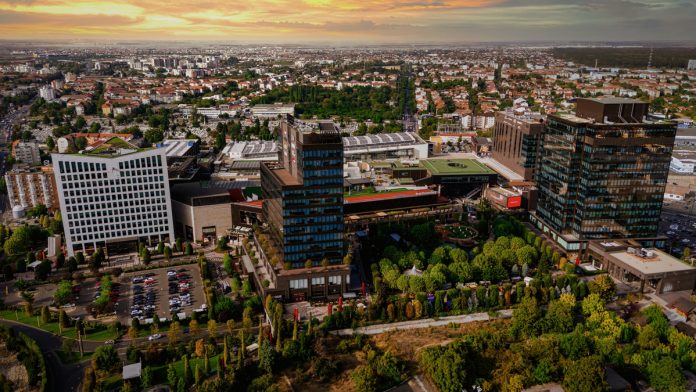
IULIUS, a group specializing in the development of urban regeneration projects in Romania, recently published their 2025 Sustainability Report. The report outlines the company’s progress in environmental, social, and governance performance and marks a stage of maturity in its sustainability strategy, in which ESG criteria are increasingly integrated into both the operation of the existing portfolio and the decisions regarding investment, financing, and the development of new urban reconversion projects.
Key figures:
- € 1.3 billion – estimated investments in the developments in progress (RIVUS Cluj-Napoca, Palas Iași remodeling, Family Market Tomești, Constanța urban reconversion project)
- € 400 million – syndicated green loan for RIVUS Cluj-Napoca
- € 29 million – investment in the most extensive private bioremediation project in Europe (former oil products storage platform spanning 38 hectares)
- 8 projects in Iași, Cluj-Napoca, Timișoara, and Suceava – 100% certified per international green building standards
- 100% renewable energy used across the portfolio
- More than 5.5 MW installed capacity in solar panels
- -73% absolute operating emissions and -86% emission intensity compared to 2019
- -22% absolute water consumption, -19% waste generation intensity
- 180,000 square meters of created green spaces
“In 2025, sustainability has become even more prominent in the way we invest and develop. We reached a new level, where the focus is on integrating ESG criteria as early as the initial phases of the investment, from concept and financing to brownfield regeneration. RIVUS Cluj-Napoca and the regeneration project in Constanța are two relevant examples. In the former case, sustainability performance is integrated even in the financing structure and requirements; in the latter case, the investment begins by addressing a complex environmental problem that has developed over time. For both projects, we chose leading architecture companies, present for the first time in Romania and also recognized for integrating sustainability in their design approach. Our goal is for environmental performance, the benefits for the community, and long-term economic value to be addressed together, from the very first phases of an investment,” said Dan Chelaru, Group Sustainability Officer IULIUS.
Responsible operational management
IULIUS’ sustainability strategy has made progress across the operational portfolio, with a core goal to reduce Scope 1 & 2 operational emission intensity and direct and indirect emissions, respectively, by 78.9% by 2030, compared to 2019 levels. This goal is directly supported by the use of 100% renewable electricity in all existing projects, along with the company’s own 5.5 MW-plus photovoltaic capacity, which covers approximately 10% of its annual demand. The efficiency of this energy transition, coupled with resource optimization, is already reflected in the reported results: 73% decrease in absolute operational emissions and 86% decrease in their intensity, such evolution being correlated with the 22% reduction in absolute water consumption and 19% reduction in waste generation intensity compared to the base year 2019.
Sustainability performance, from financing to the first works
In 2025, IULIUS and Atterbury Europe obtained a € 400 million syndicated green loan for RIVUS Cluj-Napoca, the largest loan granted to a real-estate development in Romania to that date. The loan integrates sustainability requirements for the entire development-operation-refinancing cycle, including the achievement of LEED Platinum and EDGE Advanced certifications. RIVUS, whose construction started in March, entails the regeneration of 14 hectares of a former industrial platform and will integrate more than 52,000 square meters of green spaces and comprehensive solutions for alternative mobility and energy efficiency, along with the reconversion of buildings of significant industrial heritage value to the local community. The sustainability criteria will be integrated in the design, construction, and future operation of the complex, by developing nZEB buildings, energy efficiency and renewable energy generation solutions, environmentally friendly transportation infrastructure, alleys that allow water to flow, and solutions designed to support biodiversity.
Also in 2025, IULIUS kickstarted the largest private bioremediation process in Europe, targeting 38 hectares of Oil Terminal’s former north platform in Constanța; the brownfield will undergo a major urban reconversion process. The investment allotted to the remediation is estimated upwards of € 29 million and entails treating both the contaminated soil and underground water. The operation precedes the development of a mixed-use project upwards of € 800 million, with cultural, office, and retail uses, educational concepts and public interest facilities, as well as a park built from scratch.
Nature and green infrastructure
Integrating nature into urban projects remains one of the company’s strategic priorities. IULIUS’ portfolio includes more than 180,000 square meters of gardens and green spaces, which were made possible through total investments upwards of € 20 million and form genuine anchors for the community. The new projects will continue to expand the green footprint of their respective cities through spectacular gardens built from scratch. More than 2,000 mature trees selected for these gardens are acclimating in the company’s nurseries.
Community involvement
Every year, IULIUS projects host 1,000-plus initiatives in the field of education, culture, sports, health, and environmental protection, as their public spaces serve as meeting places and platforms for the local communities. The magnitude of the economic impact also reflects in the direct revenue generated from taxes and fees related to the IULIUS portfolio, exceeding a cumulated € 330 million by the end of 2025.
In 2025, the social component of the ESG strategy also continued with programs dedicated to education and youth, cultural and sports initiatives, environmental campaigns and projects developed in partnership with local organizations and communities. One such example is the Rising Stars program, one of the most appreciated among students and graduates. In 2025, there were 821 young applicants for the 24 available spots, and IULIUS hired 12 of them at the end of the internship program.