

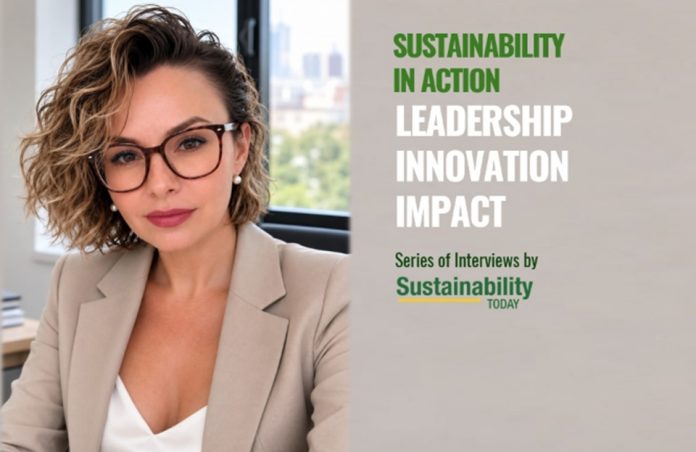
In the new editorial series of interviews, Sustainability in Action – Leaders’ Innovation Impact, Sustainability Today invites leaders in business to participate in an interview celebrating excellence in sustainability leadership across sectors. This editorial initiative recognizes organizations, projects, and individuals who demonstrate outstanding leadership, innovation, and measurable impact in advancing sustainable practices.
Find below the latest Interview with Alina Elena Trufas, Sustainability Manager, METRO Romania, detailing on the strategic priorities this year, the breakthrough endeavors, challenges and impact of new technologies and positioning within the market landscape in Romania.
As sustainability priorities continue to evolve, what are the key strategic sustainability goals and leadership priorities for your organization in 2026, and how are they shaping business decisions across the organization?
In 2026, our priorities focus on strengthening ESG governance and reporting capabilities, advancing responsible resource management across our operations and value chain, and preparing for the evolving European regulatory landscape. One important focus is the continued integration of sustainability into decision-making through stronger governance, reliable data, and clear accountability.
Our voluntary alignment with the European Sustainability Reporting Standards (ESRS) has helped us improve internal processes, strengthen cross-functional collaboration, and enhance the quality and consistency of sustainability-related information. Alongside reporting, we continue to focus on topics that are highly relevant for wholesale, including food waste reduction, responsible sourcing, packaging and circular economy initiatives, climate-related data management, and supply chain transparency.
Can you share some of the sustainability projects and initiatives that best demonstrate innovation within your organization? What challenge was it designed to address, and what measurable environmental and social impacts has it achieved?
One of our most relevant initiatives is our continued work on food waste prevention and food donation. Food waste represents both an environmental and a social challenge. Our approach prioritizes prevention through operational improvements, stock management, and process optimization. Whenever products remain safe and suitable for consumption but can no longer be sold, we work together with National Food Bank Federation to redirect surplus food to people in need. This approach helps reduce waste while generating meaningful social impact for local communities. Another important area is the development of more structured ESG data management and governance processes. Although these initiatives are less visible externally, they are fundamental for informed decision-making, transparent reporting, and compliance with evolving sustainability requirements.
How do you ensure that sustainability objectives are integrated into core business operations, governance, and long-term value creation rather than remaining standalone initiatives?
Integration starts with governance.
At METRO Romania, sustainability involves multiple business core departments including teams across Purchasing, Packaging, Operations, and supporting business functions. This cross-functional approach helps ensure that sustainability considerations become part of existing business processes rather than remaining isolated initiatives. The increasing reporting and assurance requirements under the European sustainability framework have also accelerated the maturity of our internal controls, data ownership, and accountability mechanisms. From our perspective, sustainability creates value when it helps organizations better understand risks, identify opportunities, improve resource efficiency, and strengthen long-term resilience.
This is why we increasingly see sustainability not as a separate agenda, but as an integral part of our business transformation.
Effective communication is essential for driving engagement and accountability. How does your organization communicate sustainability performance and impact to stakeholders, and what approaches have proven most effective in building trust and transparency?
Communication sustainability has evolved significantly in recent years. Stakeholders increasingly expect information that is transparent, relevant, and supported by evidence.
At METRO Romania, we communicate sustainability performance through formal reporting, continuous stakeholder dialogue and ongoing engagement with employees, customers, suppliers, and industry partners. The publication of our Sustainability Statement, prepared in alignment with the European Sustainability Reporting Standards (ESRS), represented an important milestone. Beyond regulatory preparedness, the reporting process has strengthened internal transparency, clarified data ownership, and encouraged a more structured dialogue across the organization.
Communicating both progress and ongoing challenges helps create more meaningful stakeholder engagement and supports long-term credibility.
What is the role of technology, digital solutions, and artificial intelligence in advancing your sustainability strategy, improving decision-making, or enhancing the measurement and management of sustainability performance?
Technology is becoming increasingly important in sustainability, particularly in the areas of data management, traceability, reporting, and risk assessment.
As sustainability requirements continue to evolve, organizations need reliable digital systems capable of collecting, validating, and consolidating large volumes of information across functions and value chains.
At METRO Romania, we see technology primarily as an enabler of better decision-making. Reliable sustainability data supports more informed business decisions, improves transparency, and strengthens governance. The growing focus on supply chain transparency, including requirements such as the EU Deforestation Regulation (EUDR), further highlights the importance of digital traceability solutions capable of managing increasingly complex supplier and product information.
Artificial Intelligence also offers significant opportunities. While many applications are still evolving, AI can support data analysis, document processing, identification of anomalies, supply chain visibility, and interpretation of increasingly complex sustainability requirements.
At the same time, technology alone is never enough. The quality of decisions ultimately depends on the quality of data, robust governance processes and the expertise of the people using these tools.
Technology and human judgment should therefore be viewed as complementary capabilities.
Looking ahead, what emerging sustainability trends, innovations, or technologies do you believe will have the greatest influence on organizations seeking to create meaningful environmental and social impact over the next few years?
Several developments are likely to shape the sustainability agenda over the coming years.
First, we see a clear shift from sustainability commitments towards greater accountability, transparency, and measurable performance. Organizations are increasingly expected not only to define ambitions but also to demonstrate measurable progress. Second, supply chain transparency and traceability will continue to gain importance. Companies are being asked to better understand impacts, risks, and dependencies throughout increasingly complex value chains.
In sectors such as retail and consumer goods, the growing focus on packaging circularity, product transparency and digital product information is also expected to accelerate innovation and collaboration across value chains, including the future implementation of initiatives such as Digital Product Passports. Digitalization and Artificial Intelligence will further support this transformation by enabling organizations to convert sustainability data into actionable insights and improve decision-making.
Finally, collaboration will become one of the most important success factors. Challenges such as climate change, circular economy and responsible sourcing cannot be addressed by individual organizations acting alone. Long-term progress will increasingly depend on partnerships across industries, supply chains, public authorities, and civil society.
Ultimately, I believe that the organizations best positioned for the future will be those that combine innovation with strong governance, transparency and collaboration, creating sustainable value for both business and society.