

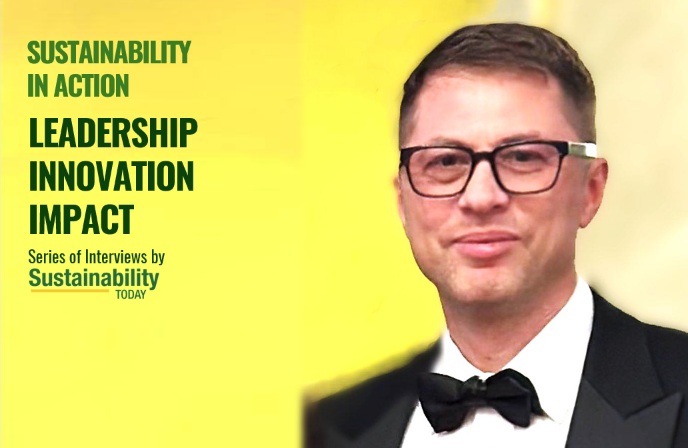
In the new editorial series of interviews, Sustainability in Action – Leaders’ Innovation Impact, Sustainability Today invites leaders in business to participate in an interview celebrating excellence in sustainability leadership across sectors. This editorial initiative recognizes organizations, projects, and individuals who demonstrate outstanding leadership, innovation, and measurable impact in advancing sustainable practices.
Find below the latest Interview with Ionel Ciucioi, Executive Director, Rompap, The Employers’ Association of the Pulp and Paper Industry in Romania, detailing on the strategic priorities this year, the breakthrough endeavors, challenges and impact of new technologies and positioning within the market landscape in Romania.
1. As sustainability priorities continue to evolve, what are the key strategic sustainability goals and leadership priorities for your organization in 2026, and how are they shaping business decisions across the organization?
The paper and cardboard industry is, by its very nature, a pillar of the circular economy: our products are 100% recyclable, renewable and biodegradable, and around 85% of the fibre used by our members in packaging business is recycled. ROMPAP represents the Romanian pulp and paper industry — companies with a combined turnover of close to one billion euros, more than 5,000 direct employees, supplying roughly 90% of the packaging used in Romania. For 2026, our strategic priorities are built around three axes. First, keeping the circular loop closed at home: Romania collects over 750,000 tonnes of recovered paper annually, yet around a quarter of it is exported, recycled abroad and re-imported as finished product, while domestic recycling capacity remains underused. Our priority is to see mechanisms in place that prioritise the internal demand for this essential raw material. Second, competitiveness in the energy transition: energy can represent up to 35% of a paper mill’s production cost, and we are advocating for the inclusion of our industry among the vulnerable, energy-intensive sectors eligible for support, as is already the case in other European countries. Third, supporting Romania’s national recycling targets — 75% for paper and cardboard, rising to 85% by 2035 — with real, measurable progress. These priorities shape our members’ decisions daily: investments in energy efficiency, in recycling capacity and in modern technology are no longer optional, they are the core of every business plan in this industry.
2. Can you share some of the sustainability projects and initiatives that best demonstrate innovation within your organization? What challenge was it designed to address, and what measurable environmental and social impacts has it achieved?
One initiative I would highlight is the national study we conducted together with Ipsos Romania on how Romanians relate to sustainability and recycling. It addressed a real gap: we had targets and infrastructure debates, but little solid data on the consumer side. The findings were revealing — Romanians are increasingly concerned about sustainability and open to responsible choices, but significant barriers remain around information, infrastructure and, importantly, trust in the recycling process itself. This evidence now underpins both our public awareness campaigns and our dialogue with authorities, because no collection system works without citizens’ confidence that what they sort is actually recycled.
At the level of our member companies, innovation is visible in the continuous closing of the loop: recycled paper already provides around 89% of the raw material for new corrugated packaging produced in Romania, and paper remains the recycling champion among packaging materials, with recycling rates of 65–70% in Romania and around 75–84% at European level. Members have invested consistently in operational efficiency and in integrated collection–recycling–production flows, which means corrugated packaging collected after use returns to the market as new packaging again and again. The measurable impact is direct: less landfill, lower emissions, conserved forest resources and thousands of stable industrial jobs in local communities.
3. How do you ensure that sustainability objectives are integrated into core business operations, governance, and long-term value creation rather than remaining standalone initiatives?
In our industry this question has a particular answer: sustainability is not a department, it is the business model. When 85% of your raw material is recycled fibre, the security of your supply chain and the performance of the national collection system are one and the same issue — circularity is an operational necessity, not a communication exercise. That said, I believe strongly that recycling must stop being treated, anywhere in the economy, as mere compliance with legislation. It has to be embedded in the value chain and in value creation for companies. At association level, we ensure this integration through governance: ROMPAP is a member of CEPI and FEFCO, so our members’ strategies are aligned with European industry policy on circular economy, decarbonisation and packaging regulation; as a founding member of CONPIROM we carry these objectives into national social dialogue; and our internal working groups translate regulatory developments — from extended producer responsibility to the correct application of the polluter-pays principle — into concrete operational practice for members. Long-term value creation depends on getting this framework right: a correct legislative environment that supports collection and recycling is what turns sustainability targets from paper commitments into functioning industrial reality.
4. Effective communication is essential for driving engagement and accountability. How does your organization communicate sustainability performance and impact to stakeholders, and what approaches have proven most effective in building trust and transparency?
We communicate on three levels, and the common denominator is data. Towards public authorities and policymakers, we present verifiable industry figures — collection volumes, recycling rates, capacity utilisation, cost structures — in conferences, position papers and direct dialogue; in a debate about the circular economy, credible numbers are worth more than any slogan. Towards the general public, we run education and awareness campaigns on paper recycling, grounded in the Ipsos research, because the study showed us precisely where trust breaks down: people need to understand what happens to the paper they sort. And towards the business community, our members increasingly report sustainability performance under European frameworks such as CSRD, which brings a welcome standardisation and comparability. What has proven most effective in building trust is honesty about difficulties as well as achievements. We speak openly about the challenges — energy costs, raw material leaving the country, infrastructure gaps — and this transparency has made ROMPAP a credible partner: stakeholders know that when we present a success, it is as real as the problems we acknowledge.
5. What is the role of technology, digital solutions, and artificial intelligence in advancing your sustainability strategy, improving decision-making, or enhancing the measurement and management of sustainability performance?
Technology is central on two fronts: efficiency and traceability. On the efficiency side, in an industry where energy can reach 35% of production cost, digital energy-management systems, process automation and AI-assisted optimisation of paper machines translate directly into lower consumption and lower emissions per tonne of product — sustainability and competitiveness point in the same direction. Modern sorting technologies, increasingly supported by artificial intelligence, are also improving the quality of recovered paper streams, which raises recycling yields and reduces losses in the process. On the traceability side, digitalisation is transforming how sustainability is measured and managed: reliable data on collection, material flows and recycled content is the foundation for everything from CSRD reporting to the verification of national recycling targets, and emerging instruments such as the digital product passport will take this further. For an association like ours, better data also means better advocacy — we can demonstrate with precision, for example, how much collected material leaves the country and what capacity remains unused, and build the case for policy on that evidence. AI will not replace the fundamentals of papermaking, but it is already helping us do more with less, and measure it credibly.
6. Looking ahead, what emerging sustainability trends, innovations, or technologies do you believe will have the greatest influence on organizations seeking to create meaningful environmental and social impact over the next few years?
I see four developments that will shape the next few years. The first is the substitution of fossil-based materials by renewable, fibre-based solutions: the European regulatory framework on packaging is accelerating demand for recyclable paper-based packaging, and design-for-recycling will become a decisive competitive factor. The second is the strategic revaluation of secondary raw materials. In a world of economic competition for resources, recovered paper is no longer waste — it is a strategic resource, and countries that build legislative frameworks to process it domestically will capture the value, the jobs and the emissions savings; those that export it will import finished products instead. Romania must be in the first category. The third is the deepening link between decarbonisation and energy policy: industrial sustainability will only advance as fast as affordable low-carbon energy allows, and support schemes for energy-intensive industries in transition will make the difference between regions that keep their industrial base and regions that lose it. And the fourth is digital transparency — AI-supported measurement, product passports and standardised reporting will make sustainability claims verifiable, rewarding companies whose performance is real. Our industry, which has practised circularity for decades before the term existed, is well placed for this future — provided the playing field is fair.