

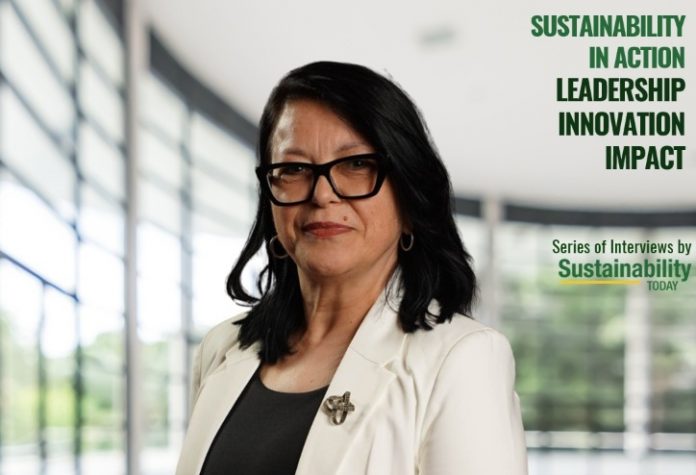
In the new editorial series of interviews, Sustainability in Action – Leaders’ Innovation Impact, Sustainability Today invites leaders in business to participate in an interview celebrating excellence in sustainability leadership across sectors. This editorial initiative recognizes organizations, projects, and individuals who demonstrate outstanding leadership, innovation, and measurable impact in advancing sustainable practices.
Find below the latest Interview with Lidia Buduroi, Head of Quality, Environment & Sustainability Management, STRABAG Romania, detailing on the strategic priorities this year, the breakthrough endeavors, challenges and impact of new technologies and positioning within the market landscape in Romania.
As sustainability priorities continue to evolve, what are the key strategic sustainability goals and leadership priorities for your organization in 2026, and how are they shaping business decisions across the organization?
Construction is changing rapidly, and sustainability is no longer a separate topic, but a part of most technical and business decisions we make.
At STRABAG, our priorities are clear: reducing carbon emissions, using materials more efficiently, expanding circular economy practices, accelerating digitalization and continuously improving health and safety. These priorities support the Group’s long-term sustainability strategy which aims to achieve specified targets in line with a science-based CO₂ reduction pathway.
For us in Romania, the challenge goes beyond implementing the Group’s strategy. We also want to contribute to showing the sustainability expertise of the local construction industry. Every project is an opportunity to demonstrate that more sustainable construction is also better construction: more efficient, more resilient and better prepared for the future.
Today, sustainability already influences how we design projects, choose suppliers, plan logistics, optimize construction processes and manage resources. It is becoming a natural part of how we build.
Can you share some of the sustainability projects and initiatives that best demonstrate innovation within your organization? What challenge was it designed to address, and what measurable environmental and social impacts has it achieved?
The biggest sustainability challenge in construction is straightforward: our industry consumes significant amounts of materials and energy. The solution is not one revolutionary technology, but thousands of better decisions throughout every project.
At STRABAG, we improve project performance through BIM, LEAN construction methods, optimized logistics, better material planning and the increased use of recycled materials wherever technical requirements allow. These measures reduce waste, lower emissions and improve efficiency without compromising quality or safety.
This continuous transformation is documented through Work on Progress, STRABAG’s communication platform, which showcases our sustainability journey, from decarbonization and circular economy to digitalization and innovation, and demonstrates how these ambitions are translated into everyday construction practice. For us, innovation is successful when it creates value simultaneously for our clients, our employees and the communities that use the infrastructure we build.
How do you ensure that sustainability objectives are integrated into core business operations, governance, and long-term value creation rather than remaining standalone initiatives?
Sustainability does not begin when construction starts. It begins much earlier, with the decisions made during planning, design and procurement.
This is where the greatest opportunities exist to reduce environmental impact, improve efficiency and optimize costs over the entire life cycle of a project. That is why sustainability is integrated into our technical and business processes rather than treated as a reporting exercise.
Strong governance, clear responsibilities and measurable performance indicators are essential, but equally important is the mindset of our teams. Sustainability should become part of everyday decision-making: from engineers and project managers to procurement specialists and site teams.
When this happens, sustainability naturally supports better project performance, stronger client relationships and long-term competitiveness.
Effective communication is essential for driving engagement and accountability. How does your organization communicate sustainability performance and impact to stakeholders, and what approaches have proven most effective in building trust and transparency?
People trust facts more than promises.
That is why we focus on communicating measurable progress rather than general ambitions. Through our sustainability reporting, ESG disclosures and the Work on Progress platform, we explain not only what we want to achieve, but also how we are achieving it. By joining the Science Based Targets Initiative (SBTi), STRABAG has committed to reducing its CO₂e emissions in order to limit global warming to 1.5°C, in line with the Paris Agreement’s goal.
But transparency also means acknowledging that transforming construction is complex. There are technical, economic and regulatory challenges, and sustainable solutions often require collaboration across the entire value chain.
Internally, we work to ensure that our colleagues understand how their daily decisions contribute to our sustainability objectives. Externally, we believe open dialogue with clients, suppliers, authorities and local communities is essential if we want to accelerate the transition toward more sustainable construction in Romania.
What is the role of technology, digital solutions, and artificial intelligence in advancing your sustainability strategy, improving decision-making, or enhancing the measurement and management of sustainability performance?
Technology is one of the strongest drivers of sustainable construction because it allows us to make better decisions before resources are consumed.
Digital tools such as BIM, data analytics and digital project management improve planning, reduce errors, optimize material use and increase transparency throughout a project’s life cycle.
Artificial intelligence will further strengthen these capabilities. It can support predictive equipment maintenance, optimize logistics, improve carbon calculations and help analyze large volumes of project data more efficiently.
Technology itself is not the objective. The objective is to build with fewer emissions, less waste, greater safety and higher productivity. Digitalization simply gives us better tools to achieve these goals.
Looking ahead, what emerging sustainability trends, innovations, or technologies do you believe will have the greatest influence on organizations seeking to create meaningful environmental and social impact over the next few years?
The future of sustainable construction will not be defined by a single technology. It will be defined by how effectively companies combine engineering expertise, digital intelligence and responsible decision-making.
Low-carbon materials, circular economy, digital carbon tracking, AI-supported project optimization and the electrification of construction equipment will all play an increasingly important role. At the same time, clients and investors will expect greater transparency regarding environmental performance and measurable sustainability outcomes.
Romania has a unique opportunity. As investment in infrastructure continues to grow, we can adopt the best practices already implemented across the STRABAG Group while helping to raise the sustainability standards of the local construction industry. Sustainability is no longer simply about compliance. It is becoming a defining factor for competitiveness, resilience and long-term success. At STRABAG, our ambition is not only to apply the Group’s sustainability strategy locally, but to contribute to shaping a more sustainable construction industry in Romania.