

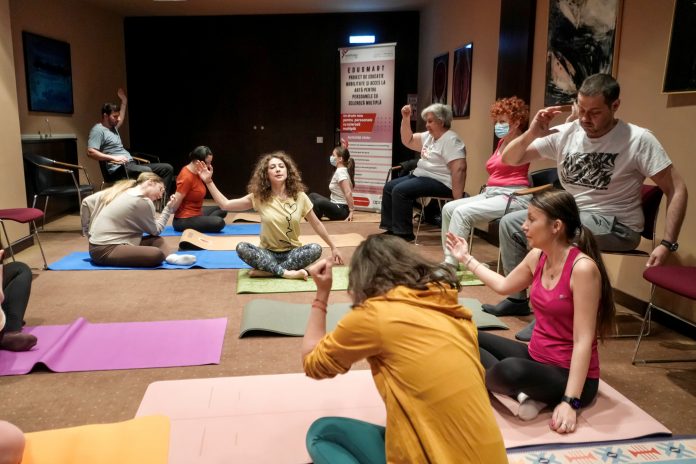
For 12 months, EduSMart brought psychotherapy, physiotherapy, yoga, adapted dance, personal development and access to culture together in a single programme for people with multiple sclerosis. Implemented by APAN Romania with the support of the Dacia Foundation for Romania, through the “Mobility Matters” programme, the project tested a support model built around the everyday lives of people with MS.
The programme started from the reality that many of the challenges brought by multiple sclerosis cannot be addressed through medical treatment alone. Fatigue, anxiety, loss of confidence in one’s own body, isolation or the difficulty of talking about the diagnosis can have a profound impact on everyday life.
Over the 12 months, the online group psychotherapy programme recorded a total of 404 attendances, while the physiotherapy component included 10 individual or group sessions for each participant. Adapted dance was delivered over two seasons, yoga included both online and in-person sessions, and the programme provided both in-person and online access to theatre performances. Communication and personal development workshops addressed topics such as difficult conversations, disclosing a diagnosis in the workplace, and how a person can talk about their condition without allowing it to define their identity.
The evaluation of the adapted dance programme shows that its impact went beyond movement. Of the 22 respondents, 82% said it improved their mental wellbeing, 64% mentioned new friendships and experiences, 59% reported greater self-confidence, and 55% said they felt less isolated. A total of 91% said they felt accepted to a great or very great extent, while all respondents said they would recommend the activity to another person with multiple sclerosis.
For Corneliu Rontescu, who was diagnosed with multiple sclerosis in 2017, the rehabilitation programme brought both improvements in mobility and greater confidence in his own body, while also giving him the opportunity to spend time with people going through similar experiences.
“I found that I could move and lift my left leg much more easily, my stability and coordination improved, and I started walking much more. For me, EduSMart also meant the opportunity to socialise and work alongside people who are going through the same experience,” says Corneliu Rontescu, an EduSMart participant.
“At the beginning, we asked ourselves what a person needs, beyond treatment, in order to continue living their life. EduSMart showed us that needs do not exist separately, and neither should the answers. Rehabilitation, emotional support, relationships, movement and participation in community life are all parts of the same life,” says Eduard Pletea, President of APAN Romania.
Some of the activities will continue after the funding period ends. APAN Romania is preparing the third season of adapted dance and aims to maintain its online psychotherapy sessions. The nine yoga and wellbeing video tutorials developed as part of the project will remain available to the community: https://www.youtube.com/@apanromania/videos
EduSMart was implemented with the support of the Dacia Foundation for Romania, as part of the “Mobility Matters” grant programme, and had a total approved budget of RON 169,880, of which RON 149,792 was provided by the Dacia Foundation for Romania and RON 20,088 represented APAN Romania’s contribution.
“For people living with multiple sclerosis, mobility means autonomy, connection and the ability to remain active in everyday life. Through the ‘Mobility Matters’ programme, we set out to support solutions that address these needs in an integrated way, and EduSMart is a very good example of this. Together with APAN Romania, we supported a 12-month programme that combined rehabilitation, psychological support, movement and access to culture. Beyond the activities themselves, people gained greater confidence, new experiences and the feeling that they are not alone. For us, this is one of the project’s most important outcomes, showing how physical mobility can work hand in hand with social mobility,” says Cătălina Murariu, Executive Director of the Dacia Foundation for Romania.