
The circular economy is one of the most important pathways to building a sustainable future. At its core lies a simple idea: products should be used for as long as possible—through reuse, repair, and, only as a last resort, recycling.
When it comes to electrical and electronic equipment, every decision to discard a device should be guided by two basic questions:
- Is it still functional? If yes, it could be donated to someone in need.
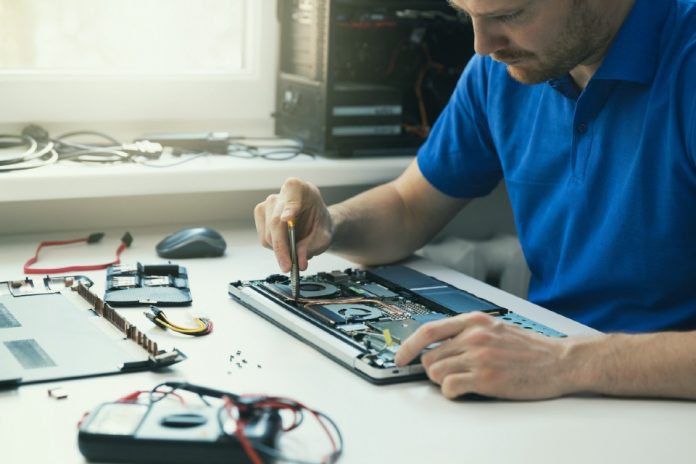
- If not, can it be repaired?
Why Repair Instead of Replace?
Choosing repair over replacement is not only practical but also brings significant benefits:
- Lower costs – repairing a device is often cheaper than buying a new one, which can be a substantial household expense.
- Environmental protection – every repaired device means fewer electrical and electronic waste (WEEE) items and less need for extracting natural resources to produce new ones.
Repair or Preparation for Reuse?
It is important to distinguish between repair and preparation for reuse (often called refurbishment). Both extend the life of equipment, but they apply at different stages:
- Repair is an intervention on a product that is still in use or has recently failed, carried out in workshops or service centers to prolong its use by the same owner.
- Preparation for reuse applies to equipment that has already entered the waste stream. Through testing, cleaning, and repair, these products are given a “second life” and reintroduced to the market as functional goods.
The European Legislative Framework
The European Union actively promotes repair and adopted several measures in 2024:
- Right to Repair Directive – obliges manufacturers to repair certain products even after the warranty period ends, ensuring access to spare parts, diagnostic tools, and technical information.
- ESPR (Ecodesign for Sustainable Products Regulation) – sets requirements for durability, reparability, recyclability, and introduces a digital product passport.
Examples from Across Europe
Some EU member states are already leading the way:
- France – with its ambitious Anti-Waste Law for a Circular Economy (AGEC), France has introduced:
- Responsible public procurement, requiring institutions to buy goods from reuse or recycled materials.
- A repairability index (1 to 10) displayed on products such as smartphones, laptops, washing machines, and vacuum cleaners.
- A repair bonus (since 2022) covering part of repair costs for electrical equipment, textiles, and footwear.
- A durability index (since 2025) for televisions and washing machines to reflect real product lifespans.
- The Netherlands – promotes “repair cafés,” community spaces where citizens can learn to fix items alongside volunteers.
- Germany – offers subsidies for repair workshops to make them more accessible to the public.
The Situation in Romania
Romania must implement the EU Right to Repair Directive by July 2026. In the meantime, initiatives focusing on reuse are already making a difference.
One example is the “Join the Solidarity Circle!” campaign, a national program for collecting and refurbishing IT equipment, run by ECOTIC and Ateliere Fără Frontiere. The goal is to donate refurbished computers to schools.
Florin Niculae, Development Director at Ateliere Fără Frontiere, explains: “This campaign allowed us not only to showcase our expertise in refurbishing IT equipment but also to build real bridges between the economic environment and vulnerable communities. Hundreds of computers, which otherwise would have become waste, were transformed into tools for education and digital inclusion.”
Sabina Pîrvulescu, Operations Director at ECOTIC, highlights the social and environmental impact:“Over 32,000 IT devices have been prepared for reuse and donated to disadvantaged communities in Romania. This proves the real impact we can achieve when sustainability and solidarity are placed at the heart of our actions.”
A Simple Act with Major Effects
Repairing electrical equipment is a small gesture with wide-reaching effects—for personal budgets, for the environment, and for society as a whole. Each device saved from landfill represents a conserved resource, a supported community, and a concrete step toward a truly circular economy.