

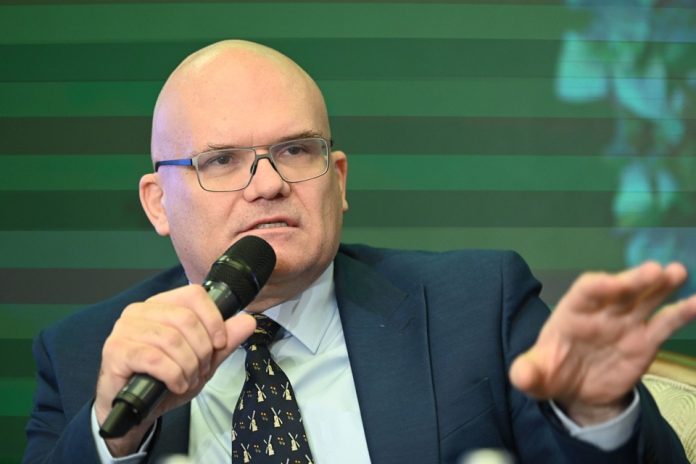
Romania’s Deposit-Return System (SGR) has proven effective in engaging citizens, though major challenges remain in the wider waste management sector, according to Raul Pop, Secretary of State at the Environment Ministry.
“The deposit-return system has demonstrated that it can engage citizens, which for all of us has traditionally been a challenge. Getting citizens involved in policies—or even in environmentally relevant behaviors—is not easy. This is also reflected in what happens with waste outside the deposit-return system,” Pop said today at the Resource Recovery Summit.
He noted that while the system performs well within its scope, it represents only a small share of Romania’s overall waste stream.
“To put things into perspective, the deposit-return system manages around 400,000 tonnes of recyclable packaging per year, out of a total of 5.5 to 6 million tonnes of municipal waste generated in Romania,” he explained.
According to Pop, the system is effective within its segment but highlights broader structural issues.
“Within its roughly 10% share, SGR is doing its job. On the remaining 90%, however, we still face very large challenges. These can be split into two categories: those where producers are obliged to finance collection, recycling and redesign, and those where we rely strictly on the funds we can collect from citizens,” he said.
He pointed to differences between waste streams covered by extended producer responsibility schemes and those that are not.
“We are talking about recyclables where extended producer responsibility already applies—such as packaging, electrical equipment and batteries—and about other types of waste where no redesign solution can significantly reduce the quantities generated,” Pop added.
Pop also highlighted disparities in collection performance across materials, particularly comparing beverage packaging with other types.
“We are in a bittersweet situation for beverage producers, who now have access to a much more efficient collection system than traditional separate collection from households. Through SGR, they have reached around 85% recovery rates from the market. By comparison, for cardboard packaging—often from the same producers as well as others—we are talking about collection rates of 20%, at most 30%,” he said.
From the Ministry’s perspective, all waste streams must be addressed in parallel, he stressed.
“From the Ministry’s side, we must look at all segments of this ‘pie’ called waste management. If these quantities are properly managed, at least at the minimum level required by legislation, we are in a good place. But we are not there yet,” Pop noted.
This gap creates tensions between public policy goals and industry concerns, he added.
“At this stage, we see—on one side—a public interest in recovering as much as possible through the most efficient instrument we have, namely the deposit-return system, and—on the other side—producers’ interest in maintaining reasonable costs. Producers have consistently pointed out that they lack control over the efficiency of these expenses. Collecting waste from the population is expensive,” Pop concluded.