

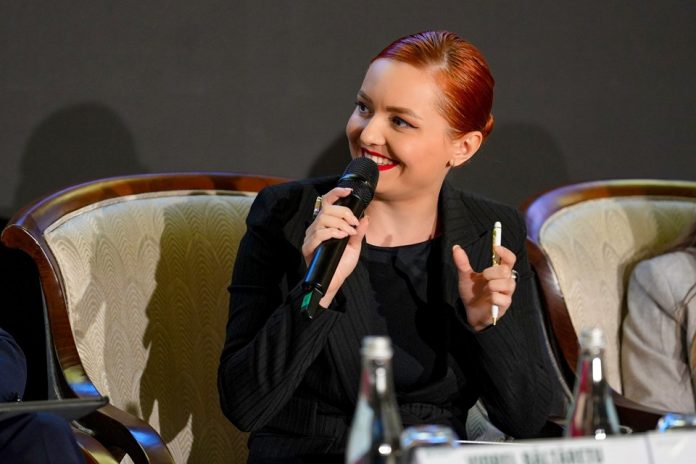
DS Smith operates with circularity at the core of its business model. In Romania, the company is active across all three divisions: paper production, packaging production, and recycling. This integrated approach allows the company to close the loop and, beyond that, offer businesses in Romania the opportunity to develop circularity projects in partnership with them.
“I believe that circularity projects can only work in practice and succeed if they deliver a return on investment; otherwise, they cannot be sold further, neither to top management nor to the market,” Denisa Boar, East EMEA Communication Manager, DS Smith said during the Circular Economy Conference organized by The Diplomat-Bucharest and Sustainability Today.
Key statements:
- “We collect an enormous amount of data and have very strong traceability of the fibre, as we call it, along the logistics chain—both within our operations and at the customer level. We have developed tools that allow us to show clients, down to the product level, how they can improve their performance metrics.”
- “At the beginning of our collaboration with the Ellen MacArthur Foundation, we developed circular design metrics. This is a circular design framework that, through eight parameters, evaluates the performance of each box we produce. Once you have data at the box level, you can easily extrapolate it to project level, annual orders, and beyond.”
- “The next step, as we realized that the design circle was too micro and we needed to scale the data, was to develop a value tool. This tool operates across the logistics cycle—covering transport and storage. Here, we can implement concrete improvements. These are projects we develop from a design perspective. I am glad to see that some companies are already developing packaging in parallel with their products, in order to take all stages into account. At the same time, there are companies that, driven by regulatory and sustainability pressures, are increasingly reviewing legacy projects. There may be logistics chains that can be improved, and through our tools and quality laboratory, we can test both packaging and the logistics chain itself.”
- “We can provide data that is far more convincing than any targets we might set. Beyond the two tools available to all our clients, we also focus heavily on know-how. We work with a wide range of businesses at different levels of maturity, and there is clearly an area where we can support them. Our design expertise can help anticipate potential challenges they may face.”
- “Our designers are trained to transition from certain difficult materials to cardboard with the highest possible recyclability rate. They are not allowed to integrate more than 2% non-recyclable material into packaging. This ensures that, even in the worst-case scenario where a cardboard box is not properly recovered, it can still be recycled and remain biodegradable in the environment.”