

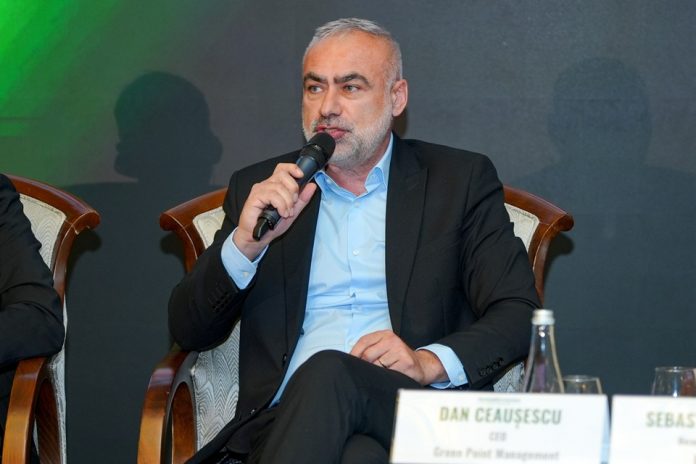
Artificial intelligence could be the next major step in the digitalisation of waste management, building on automation technologies that already handle the vast majority of data processing at GreenPoint Management, Dan Ceaușescu, the company’s CEO, said during the Sustainability in Business Forum, organised by Sustainability Today and The Diplomat-Bucharest.
The company manages large volumes of information to ensure the traceability of packaging waste throughout the entire chain, from generation and collection to sorting, processing, transportation, recycling and confirmation that recycling has taken place.
“We manage a very large amount of information in our field of activity. We ensure waste traceability from the point of generation through collection, sorting, processing and transportation to recycling, including proof that recycling has taken place,” Ceaușescu said.
He explained that managing hundreds of thousands of tonnes of different materials nationwide involves an extensive network of suppliers, particularly waste collectors and processors, generating substantial volumes of documentation that must be checked and reconciled.
Before adopting automation, the verification process relied heavily on paper records, including handwritten, stamped and manually completed documents. Employees had to check quantities across individual documents and ensure that the reported flows reconciled, while authorities conducted inspections by reviewing samples of the paperwork.
Ceaușescu said robotic process automation (RPA), using technology from UiPath, enabled the company to automate the processing of hundreds of thousands of documents.
“Before AI, the technology we relied on was UiPath’s RPA, through which we automated the processing of hundreds of thousands of documents,” he said.
“The situation has changed. Today, 97% of the processing is automated, with only a few processing errors being handled manually by our employees,” Ceaușescu added.
According to the CEO, the quantities of packaging waste entering the system and moving through the various stages up to recycling confirmation are now clearly defined, tracked and managed automatically.
This digital infrastructure provides the foundation for the company’s next technological development.
GreenPoint Management is now working on using artificial intelligence to build on its existing data-processing capabilities, with the aim of accessing information more quickly and making better use of its operational capacity.
“We are currently working on a new technology. Our intention is to use the existing foundation to process information with the help of AI, allowing us to obtain information faster and make much better use of our operational potential,” Ceaușescu said.
He pointed to differences in collection and processing performance between counties, as well as variations in the performance of individual waste collectors. Better access to data could help identify these differences and improve cooperation with partners whose own systems are becoming more advanced.
“In some counties, significantly less packaging waste is collected and processed than should be. Other counties perform better, and some collectors are much more effective. We can integrate with them on the information-processing side as they upgrade their systems,” he said.
Ceaușescu noted that further work is needed to improve the sector’s digital capabilities and make information exchange more efficient across the waste management chain.
The CEO also called for upgrades to Romania’s waste traceability system, arguing that it should offer more integration and automated data exchange.
He acknowledged that work is underway to improve the system and incorporate additional waste streams, but highlighted limitations in how information is currently transferred between participants.
At present, he said, the system functions primarily as a document repository: collectors upload documents, which are then retrieved by other parties for verification, rather than being automatically exchanged between connected systems.
“For example, there is currently no integration that allows information to be retrieved automatically. The system is, at this point, essentially a document repository where collectors upload documents and the other parties retrieve them for verification,” Ceaușescu said.
Greater interoperability could reduce manual work, improve data accessibility and support more efficient monitoring of waste flows across the sector.
Beyond technology, Ceaușescu stressed that the waste management industry is undergoing continuous change and must adapt to evolving conditions.
He said recent years have brought changes that have affected the sector in different ways, requiring companies to respond while also recognising the opportunities that transformation can create.
“Our industry is also subject to change. Sustainability now comes hand in hand with resilience and change. All the changes of recent years have had an impact, and we must constantly adapt. Of course, the impact is not exclusively negative; it can also be positive,” he said.
The Sustainability in Business Forum brings together business leaders, policymakers and sustainability professionals to discuss practical approaches to environmental responsibility, resource efficiency and the development of more resilient business models.