

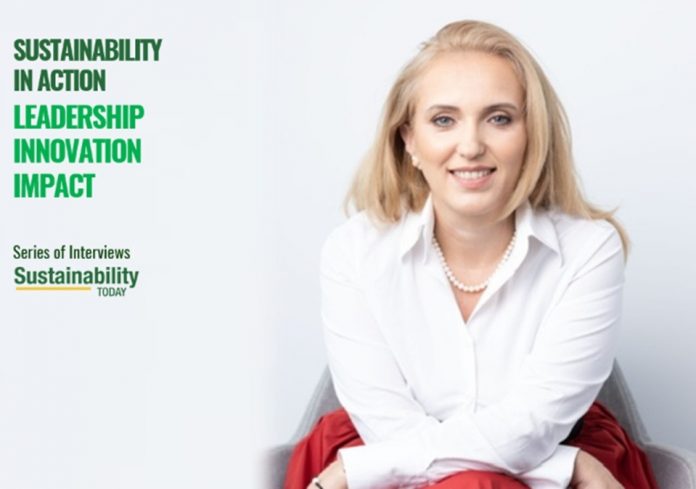
In the new editorial series of interviews, Sustainability in Action – Leaders’ Innovation Impact, Sustainability Today invites leaders in business to participate in an interview celebrating excellence in sustainability leadership across sectors. This editorial initiative recognizes organizations, projects, and individuals who demonstrate outstanding leadership, innovation, and measurable impact in advancing sustainable practices.
Find below the latest Interview with Ioana Voinescu, Head of Sustainability Department, BCR, detailing on the strategic priorities this year, the breakthrough endeavors, challenges and impact of new technologies and positioning within the market landscape in Romania.
- As sustainability priorities continue to evolve, what are the key strategic sustainability goals and leadership priorities for your organization in 2026, and how are they shaping business decisions across the organization?
The transition to a low-carbon, climate-resilient and socially inclusive economy is one of the defining challenges of our time — and it cannot be achieved without the financial sector. Banks channel capital to the businesses and projects that determine how sustainably growth happens, giving them both a responsibility and an opportunity to accelerate the transition. As a leading banking Group in the region, we are well positioned to mobilise the capital, expertise and client relationships needed to close that gap and help ensure the transition is both ambitious and just.
BCR’s most significant environmental impact arises not from its own operations but from its lending activities — specifically, the emissions associated with the projects and clients it finances. By engaging closely with clients, supporting their decarbonisation journeys and directing capital towards sustainable outcomes, we contribute to a fairer, more prosperous and more sustainable future.
As sustainability priorities continue to evolve, our strategic objective remains to accelerate the transition towards a financing model that supports the Romanian economy and the resilient development of business environment. In 2026, we are focusing on increasing the share of sustainable and transition financing across both the corporate and retail segments and increasing financial education programs.
In the corporate segment, our objective is to reach 25% sustainable financing in our portfolio. We had already exceeded 20% at the end of last year, following more than RON 4 billion in new financing provided to companies for sustainable projects in 2025. The main areas of focus are renewable energy production and green buildings, which together account for approximately 70% of our sustainable finance portfolio. We are also seeing growing interest in renewable energy projects that include energy storage components, with batteries becoming an increasingly important element in enhancing the flexibility and resilience of energy systems, as well as in energy efficiency projects for corporate and SMEs and sustainable transportation. Energy efficiency financing remains an important priority, as it contributes not only to reducing environmental impact but also to increasing companies’ operational resilience by lowering costs and improving predictability.
In the retail segment, we have set the target of reaching 15% sustainable financing at group level next year, an objective that has already been exceeded in Romania, where we are approaching 30%, supported also by a strong collection rate of energy performance certificates and incentives granted to clients.
At the same time, climate risks are becoming increasingly integrated into our financial analysis. Any resilient business model must take these risks into account, as a lack of adaptation can lead to additional costs and impact long-term repayment capacity. Therefore, sustainability is becoming an essential criterion in our financing decisions and in the way we support our clients in their transition.
2.Can you share some of the sustainability projects and initiatives that best demonstrate innovation within your organization? What challenge was it designed to address, and what measurable environmental and social impacts has it achieved?
The projects and initiatives that best showcase innovation at BCR combine sustainable financing with financial education and digital tools. On the one hand, we link our ambition of a net‑zero lending portfolio by 2050 to ongoing dialogue with clients, support for concrete emission‑reduction steps, and dedicated transition finance solutions. On the other hand, through George, the Financial Coach and financial health indicators, BCR translates sustainability into a banking experience that is more accessible and easier to measure. On the social impact side, programmes such as Școala de Bani, FLiP, LifeLab and the Mobile Caravan contribute to inclusion and resilience, including in rural or underserved communities.
We believe that ability starts with awareness and access to knowledge. Through our financial education programs, we have reached communities across Romania, including rural areas, as well as schools, kindergartens, and communities supported together with NGOs and partners. The challenge we aimed to address was the lack of equal access to financial knowledge and the need to help people make more informed decisions, strengthening financial inclusion and resilience. In partnership with Social Innovation Solutions, we support educational programs for SMEs, in Academia de Sustenabilitate and Transformator. The seventh edition of Transformator, recently launched and powered by BCR, is an intensive learning program dedicated to small and medium‑sized enterprises. Over the course of two months, participating businesses take a deep dive into their operations, critically assessing their current models and practices. Working closely with experienced mentors and subject‑matter experts, they explore new perspectives on strategy, impact, and resilience. The program culminates in the development of a concrete, sustainable growth plan, helping companies align long‑term business objectives with environmental and social responsibility.
At the same time, we are supporting the transition towards a net-zero economy. Our ambition is to achieve a net-zero lending portfolio by 2050, with specific decarbonization targets for high-emitting sectors (e.g. electricity production, automotive, real estate, oil and gas), and we recognize that this journey requires close collaboration with our clients. Through continuous dialogue, we work to understand where they are today, support them in setting realistic emission reduction steps, and provide the financial solutions needed to accelerate their transition.
3.How do you ensure that sustainability objectives are integrated into core business operations, governance, and long-term value creation rather than remaining standalone initiatives?
Sustainability is fully integrated into governance and performance management, into lending and product policies. BCR’s reporting shows that responsibility for the sustainability strategy lies with the Management Board, while the Sustainability, Diversity and Inclusion Committee monitors progress and addresses ESG themes on a regular basis. Sustainability is also coordinated across business areas, so it is reflected in policies, financing decisions, client engagement, and risk management.
In practice, this means we support clients in their transition to more sustainable business models, set targets for sustainable financing and portfolio decarbonisation, and monitor progress regularly.
The same trend is becoming increasingly visible among individual customers. We see growing momentum in sustainable housing, as more people look for energy-efficient homes and more accessible financing solutions. The fact that 29.1% of new mortgages granted by BCR in 2025 were sustainable shows that sustainable choices are becoming increasingly relevant for individuals as well.
ESG objectives are also linked to management incentives, which helps ensure accountability. Up to 10% of the variable compensation for Executive Committee members was tied to ESG performance. And climate played a major role: one-third of those ESG targets focused on the journey to net-zero emissions, covering both the company’s own operations and its portfolio.
By connecting sustainability with strategy, financing, risk management and performance monitoring, BCR Group ensures that ESG supports long-term value creation, resilience and responsible growth.
4. Effective communication is essential for driving engagement and accountability. How does your organization communicate sustainability performance and impact to stakeholders, and what approaches have proven most effective in building trust and transparency?
For us, transparency starts with showing clearly what we are working on, what progress we are making, and where we still need to improve. Our main source of information is the Consolidated Sustainability Statement, which follows European reporting standards and brings together our key sustainability priorities, actions, targets and results.
But we see communication as more than simply publishing a report. We stay connected with the people and organizations affected by our activity such as customers, employees, corporate clients, suppliers, communities, investors, regulators and NGOs, and we use their perspectives to understand which sustainability topics matter most. This input is reflected in our Double Materiality Assessment, which helps us identify the impacts, risks and opportunities that are most relevant for our business and stakeholders.
What has worked best is communicating in a simple, consistent and measurable way. We report on concrete areas such as sustainable financing, decarbonisation of our portfolio, progress toward net-zero operations, financial education, social banking, employee development and responsible business conduct. This makes our commitments easier to follow and helps stakeholders understand not only what we aim to do, but also how we are progressing.
5.What is the role of technology, digital solutions, and artificial intelligence in advancing your sustainability strategy, improving decision-making, or enhancing the measurement and management of sustainability performance?
The role of technology, digital solutions and artificial intelligence can be strengthened by linking them to performance measurement and impact scaling. BCR shows that digitalisation supports the monitoring of indicators such as sustainable financing, portfolio decarbonisation, net‑zero operations, participation in financial education programmes and social banking metrics.
At the same time, building employees’ digital, data and AI skills is treated as a prerequisite for the responsible use of new technologies and for maintaining relevance in a banking sector undergoing rapid transformation.
Through George, BCR’s digital banking platform, customers can access tools such as the Financial Coach and financial health indicators that help them better understand their financial situation, plan ahead and develop healthier financial habits. These solutions support BCR’s broader goal of promoting financial health and inclusion.
Digital tools also help extend the reach of financial education. Programs such as LifeLab.ro, Școala de Bani and FLiP provide learning resources through online and offline formats, helping teachers, students and communities build financial knowledge while allowing BCR to better track engagement and impact.
Technology and improved data availability further support sustainability performance management. BCR monitors key indicators, including sustainable financing, portfolio decarbonisation, net-zero operations, financial literacy participation and social banking metrics, enabling better understanding of impacts, risks and opportunities across the value chain.
As technology evolves, BCR also invests in developing employees’ digital, data and AI skills, ensuring they can use new technologies responsibly and continue delivering relevant, innovative and compliant banking solutions. Alongside digital transformation, maintaining trust remains essential, which is why cybersecurity, data protection and privacy are supported through robust procedures, employee training and customer awareness initiatives.
6.Looking ahead, what emerging sustainability trends, innovations, or technologies do you believe will have the greatest influence on organizations seeking to create meaningful environmental and social impact over the next few years?
Regarding trends with major impact in the coming years, the answer can be refined by highlighting the convergence between renewable energy, storage solutions, more sophisticated reporting requirements and the integration of sustainability into day‑to‑day investment and lending decisions. BCR’s reporting shows that the bank sees opportunities in financing renewable energy projects, energy infrastructure and battery storage solutions, while also recognising the need to better understand climate, nature‑related and social risks within its portfolio. In terms of biodiversity, BCR has already identified a material negative impact associated with its financed portfolio related to soil sealing and has expanded its Responsible Financing Policy with exclusion criteria for activities and projects located in protected areas or generating significant adverse impacts on them. This evolution suggests that the next stage of sustainability maturity will involve an increasingly granular integration of nature and transition risks into banking processes.
We believe that the biggest opportunities for creating meaningful environmental and social impact will come from accelerating the transition to a more sustainable economy, one where innovation, technology, and financial education work together to enable real change.
Renewable energy will continue to be one of the most important areas of transformation. Solutions such as wind and solar energy, together with battery storage technologies, will help organizations reduce emissions and build a more resilient energy system. At BCR Group, we see our role as more than just providing financing, we aim to support projects that contribute to the energy transition and resilience of energy networks, while creating long-term value for both businesses and society. We have on our long-term agenda important topics as energy efficiency, which comes hand in hand with industrialization strategy of Romania, circular economy, sustainable agriculture and building renovation.
The agri‑food sector holds a unique place in sustainability debates, as it is both a major driver of environmental pressures and the first to feel their direct effects. Today it is undergoing one of the deepest structural transformations in its modern history, shaped by climate stress, tightening regulation and shifting consumer preferences. In Romania, the agri‑food sector sits at the intersection of three structural forces: safeguarding food security and resilience amid geopolitical and climatic volatility, raising competitiveness and added value through modernisation, processing and value‑chain integration, and overcoming financial and governance constraints in a field highly exposed to natural and market risks and marked by significant information asymmetries.
We also expect sustainability to become increasingly embedded in everyday business decisions, from the way buildings are designed and built to how companies invest and grow. The strong demand for sustainable financing shows that organizations are increasingly looking for solutions that help them reduce their environmental impact while remaining competitive.