
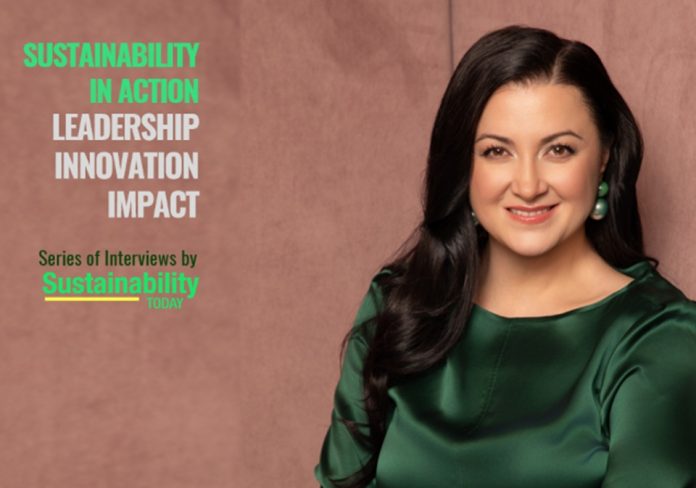
In the new editorial series of interviews, Sustainability in Action – Leaders’ Innovation Impact, Sustainability Today invites leaders in business to participate in an interview celebrating excellence in sustainability leadership across sectors. This editorial initiative recognizes organizations, projects, and individuals who demonstrate outstanding leadership, innovation, and measurable impact in advancing sustainable practices.
Find below the latest Interview with Irina Siminenco, Corporate Affairs Manager, Nestlé Romania, detailing on the strategic priorities this year, the breakthrough endeavors, challenges and impact of new technologies and positioning within the market landscape in Romania.
Nestlé Romania marks three decades of local operations in 2026, and sustainability remains one of the structural pillars of its strategy, not a side component. At Group level, Nestlé is targeting net zero greenhouse gas emissions by 2050 at the latest, with an interim target of cutting emissions by 50% by 2030 against a 2018 baseline, a trajectory the company is already ahead of, having reported a net reduction of 24.5% to date. In Romania, that global direction is translated into local, hands-on programs spanning nutrition education, environmental protection, and packaging circularity, built together with NGO-s, schools, and local communities.
- As sustainability priorities continue to evolve, what are the key strategic sustainability goals and leadership priorities for your organization in 2026, and how are they shaping business decisions across the organization?
Sustainability, for us, isn’t a separate chapter of strategy anymore, it’s how we make decisions, every day. At Group level, we have a very clear reference point, the Net Zero Roadmap, through which we’ve committed to net zero emissions by 2050 at the latest and a 50% reduction by 2030 from 2018. We’re already ahead of that curve, with a net reduction of 24.5%, which gives us confidence that the direction is right, but also the responsibility not to slow down.
Regenerative agriculture is the number 1 sustainability priority in Nestlé globally and in Zone Europe. Over ⅔ of our GHG emissions globally are coming from agriculture, from suppliers of raw material, and in Romania we are selling products that contain those ingredients, like coffee, Maggi, chocolate. Also, recyclable packaging is the second big bet in Zone Europe for us.
In Romania, we translate that commitment into three pillars that reinforce one another. The first is nutrition education, buit on our Nestlé for Healthier Kids initiative, which brings together everything we do to support parents and caregivers in raising healthier children, from product research and formulation to education and nutrition services. Locally, that means partnering with the PRAIS Foundation on the national movement called ‘I Live Healthy Too – SETS‘, and with the Healthy Traditions Foundation on the ‘Healthy Bag‘ program developed by prof. dr. Veronica Mocanu. It also means very concrete tools: our Nestlé for Healthier Kids Recipe Book, NutriPlate, VeggiePlate, and our annual International Chefs Day campaign, which promotes cooking together with young children. The second pillar is environmental protection, through projects such as Nestlé Honey Forest, Blue Planet Counts on You, Less Waste More Love, POPAS, and Iubesc Apa (I Love Water). The third is circularity, through our Nespresso and NESCAFÉ Dolce Gusto capsule recycling programs. None of these sit outside the business, they’re part of how we relate to the community we’ve been part of for 30 years.
- Can you share some of the sustainability projects and initiatives that best demonstrate innovation within your organization? What challenge was it designed to address, and what measurable environmental and social impacts has it achieved?
As i was mentioning above, for us regenerative agriculture and maintaining the quality of the soil in general and keeping the soil healthy are priorities. During the past six years we have noticed that in some parts of Romania the soil is degraded because of conventional agriculture, over use of mineral fertilizers and soil disturbing, as well as other factors. In this regards, we have developed three very important projects for us: Honey Forest, a project of reforestation and protection of soils that have been severely degraded and Blue Planet Counts on You, an educational and awareness project and a circularity project for our coffee businesses.
Honey Forest started from a very concrete problem, degraded agricultural soil in southern Romania, and we responded by planting acacia trees, which absorb carbon and, at the same time, provide bees with a vital pollen source. We’ve planted 120,000 trees so far, and in 2026, as we mark 30 years of activity in Romania, we’ll plant another 30,000. It’s the kind of project where you can literally watch the impact grow, year after year. Southern Romania’s soil degradation, the challenge Honey Forest Programme was designed to address, is a documented and worsening phenomenon. The phenomenon stems from a combination of prolonged drought, rising temperatures, and reduced rainfall, compounded by decades of lost protective forest shelterbelts that once stabilized the soil. An official Ministry of Environment, Waters and Forests report from May 2026 found over 11.29 million hectares nationwide susceptible to aridification and potential desertification, with the Romanian Plain, the Moldavian Plateau, and part of Dobrogea accounting for more than 8.3 million of those hectares.
Blue Planet Counts on You, developed with the PRAIS Foundation as part of the PACT project, is particularly close to my heart because it works with the youngest among us, primary school students and teaches them things that are simple but essential: how to sort recyclable waste at home and at school, the benefits of planting and caring for trees, shrubs, or houseplants, how to save water and electricity, and why it matters to keep communities, green spaces, forests, rivers, lakes, and seas clean. Between 2021 and 2025, 107,000 primary school students benefited from the project, and in the 2025–2026 school year, 312 schools across 31 counties and 179 urban and rural localities have enrolled. To me, that means environmental education is no longer a pilot, it’s a practice at scale.
On circularity, we are proud of the recycling ecosystem we have built around portioned coffee. Nespresso launched its capsule recycling program in Romania in 2018, making it easy for coffee lovers to give their used capsules a second life. Today, customers can return used capsules free of charge in Nespresso stores, through courier collection when receiving a new order, or through designated collection points. Collected capsules are processed by Nespresso’s local recycling partner, where the coffee grounds are separated from the aluminum, a 100% recyclable material that can be reused. From each recycled coffee capsule other objects can be formed that you will encounter every day – for example other capsules, bicycles, or watch cases. The coffee grounds, once separated from the aluminum, can be reused in ever more innovative ways. Today, you can find it in fertilizers or renewable energy. Each capsule we recycle can give life to a new product. And thus, we ensure the circularity of the materials we use and are closer to our vision of providing memorable experiences to coffee lovers. Through this program, Nespresso aims to ensure that the valuable materials contained in each capsule remain in use for as long as possible, contributing to a more sustainable future.
NESCAFÉ Dolce Gusto runs a parallel program for plastic capsules, with 74 collection points in cities including Bucharest, Băbeni, Brăila, Brașov, Cluj-Napoca, Constanța, Iași, Ploiești, Râmnicu Vâlcea, and Timișoara. From there, capsules go to partner recycling centers, where plastic and aluminum are separated from the coffee grounds, which are typically converted into biogas or compost.
- How do you ensure that sustainability objectives are integrated into core business operations, governance, and long-term value creation rather than remaining standalone initiatives?
I think the clearest proof that sustainability is embedded, not bolted on, is that our nutrition tools keep evolving as part of our regular product and portfolio planning, the same way any core business line would. NutriPlate and VeggiePlate weren’t launched once and left untouched. In 2022, we made both available in Braille for people with visual impairments. In 2025, we launched NutriPlate for Adults. And in 2026, we’re preparing to launch NutriPlate for Breakfast. That kind of continuous roadmap only happens when a effort is seen as a living part of the business, revisited and expanded year after year, rather than parked as a one-off initiative. The same logic applies to Nestlé for Healthier Kids as a whole: it isn’t a communications campaign sitting next to the business, it spans R&D and formula development on one side, and education and nutrition services on the other. At Group level, this discipline extends into governance itself and emissions-related indicators are built directly into executive variable compensation, alongside nutrition-related metrics. When sustainability shows up in how you formulate products, how you plan your annual roadmap, and how leadership is compensated, it stops being a separate project and becomes part of how the company is actually run.
- Effective communication is essential for driving engagement and accountability. How does your organization communicate sustainability performance and impact to stakeholders, and what approaches have proven most effective in building trust and transparency?
In my experience, the most effective form of communication isn’t the one where we talk about impact, it’s the one where people experience it themselves. At Group level, we publish rigorous non-financial reporting, aligned with international climate disclosure standards. But in Romania, what really builds trust are the partnerships on the ground: with the PRAIS Foundation, with the Healthy Traditions Foundation, with schools across the country. Take our nutrition education work: through the ‘I Live Healthy Too – SETS‘ movement and the ‘Healthy Bag‘ programme, together with our Recipe Book and our annual International Chefs Day campaign, we’re not just telling parents what a balanced meal looks like, we’re getting families into the kitchen together, cooking with their children. Or take Blue Planet Counts on You, now reaching 312 schools in 31 counties: when a child learns to sort waste at school and brings that habit home, that message travels further and lands more credibly than any campaign we could run on our own. Communication, in that sense, stops needing a channel, it becomes a personal experience and that’s what stays with people.
- What is the role of technology, digital solutions, and artificial intelligence in advancing your sustainability strategy, improving decision-making, or enhancing the measurement and management of sustainability performance?
At Group level, digitalization and advanced traceability tools play an increasingly important role. In 2025, for instance, we reached 96.7% assessed deforestation-free performance across our primary supply chains: meat, palm oil, pulp and paper, soy, sugar, cocoa, and coffee. That kind of close monitoring, across such varied commodities, simply isn’t possible without robust digital supply chain monitoring systems. Locally, technology shows up most visibly in how we make information accessible. Creating NutriPlate and VeggiePlate in Braille, starting in 2022, meant rethinking the format itself so it could reach people who couldn’t see and use the standard printed or digital versions. And on the circularity side, what looks like a simple ‘collection point’ is really a small logistics network behind the scenes. The free courier return for Nespresso capsules, or the 79 physical NESCAFÉ Dolce Gusto collection points spread across ten cities, only work at scale because of the operational infrastructure and tracking behind them. It’s not always visible technology, but it’s technology that makes circularity actually functional, rather than hypothetical.
- Looking ahead, what emerging sustainability trends, innovations, or technologies do you believe will have the greatest influence on organizations seeking to create meaningful environmental and social impact over the next few years?
We belive that a few directions will really matter in the coming years. The first is regenerative agriculture, which needs to become the rule rather than the exception. Since, at Group level, dairy ingredients and livestock farming account for roughly 30% of our emissions. The second is genuine packaging circularity. We’ve moved past the point where ‘recyclable‘ was enough, and the natural next step is reuse and refill, built on the kind of collection infrastructure we’ve already established with Nespresso and NESCAFÉ Dolce Gusto. The third is the increasing convergence between sustainability and public health. We can see it in the way our own nutrition tools keep expanding: from NutriPlate and VeggiePlate to NutriPlate for Adults in 2025 and NutriPlate for Breakfast in 2026, with environmental and nutrition education increasingly woven into a single narrative. We’ll also keep seeing more due diligence on how companies validate their emissions commitments with real data. Beyond all of that, we believe that projects built together with the community, from schools and families to local partners, are the ones that overtake lasting change.