

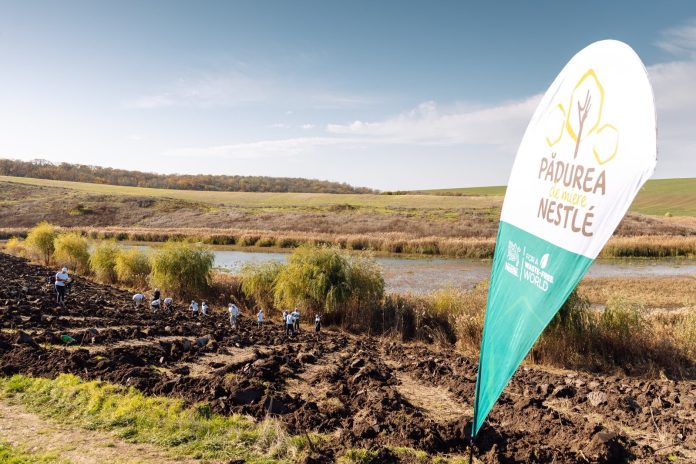
Nestlé Romania is marking 30 years of operation by planting 30,000 acacia saplings as part of the ‘Nestlé Honey Forest’ project, now in its sixth year. The planting, carried out across an area of 6 hectares in the village of Căscioarele, Călărași County, brings the total number of trees planted by the company in southern Romania since 2020 to 150,000.
“Nestlé Honey Forest” is an initiative that brings together the company’s efforts to promote biodiversity, support local communities and contribute to the restoration of degraded soils through reforestation in areas of the south of the country that are degraded and at risk of desertification. The acacia tree is one of the main honey-producing species, with acacia honey being well known for its distinctive taste and properties. Each new plantation thus becomes, over time, a source of food for bees and a resource for local beekeepers.
The project is being implemented in partnership with the Re-Autentic Association, the technical partner, alongside the Căscioarele Commune Council in Călărași County.
“To mark three decades in Romania, we have chosen an initiative that will grow alongside the local communities. The 30,000 acacia trees planted across 6 hectares this year are our way of thanking the communities with whom we have grown. From our very first plantings, we have learnt that an environmental project only makes sense if it is continued year after year and if it brings tangible benefits: restored soils, more food for bees and new resources for beekeepers. Bees need human support to find new suitable habitats. We are proud to be able to contribute, for the sixth consecutive year, to the restoration of degraded agricultural land in the south of the country. We are grateful to have partners in the Re-Autentic Association and the Căscioarele Commune Council with whom we are continuing this project”, says Irina Siminenco, Corporate Affairs Manager, Nestlé Romania.
“The acacia tree adapts well to drought and the poor soils of the Romanian Plain, and its roots stabilise the soil and reduce erosion. Generally, acacia honey production ranges from 800 to 2,000 kilograms per hectare. Once mature, this year’s plantation in Căscioarele could provide food for bees equivalent to 4.8 to 12 tonnes of honey, provided that local beekeepers are encouraged and, consequently, supported by both local and county authorities”, says Floriana Coman, President of the Re-Autentic Association.