

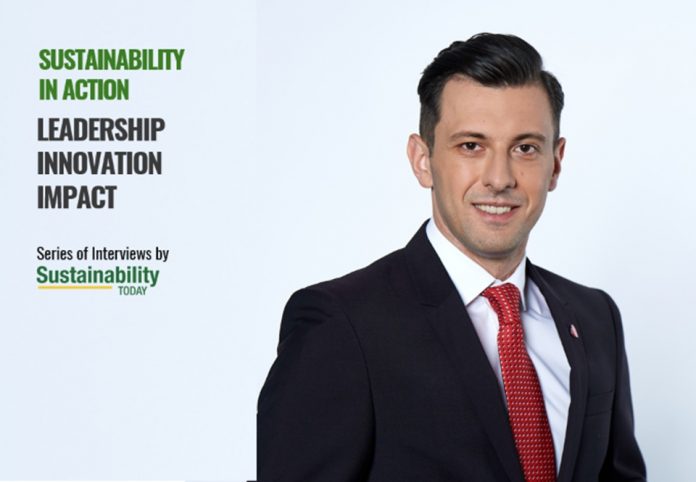
In the new editorial series of interviews, Sustainability in Action – Leaders’ Innovation Impact, Sustainability Today invites leaders in business to participate in an interview celebrating excellence in sustainability leadership across sectors. This editorial initiative recognizes organizations, projects, and individuals who demonstrate outstanding leadership, innovation, and measurable impact in advancing sustainable practices.
Find below the latest Interview with Cristian Moldovan, Corporate Affairs & Sustainability Director, Coca-Cola HBC Romania, detailing on the strategic priorities this year, the breakthrough endeavors, challenges and impact of new technologies and positioning within the market landscape in Romania.
As sustainability priorities continue to evolve, what are the key strategic sustainability goals and leadership priorities for your organization in 2026, and how are they shaping business decisions across the organization?
In 2026, Coca‑Cola HBC Romania’s sustainability priorities are shaped by the Group’s Mission Refresh framework, which marks the next chapter after Mission 2025. The strategic direction is built around four flagship commitments: achieving net zero emissions by 2040, replenishing every drop of water used in beverages by 2035, achieving a net positive impact on biodiversity by 2040, and being the neighbour of choice for local communities. These commitments are ambitious, measurable, and backed by actions and investments.
Can you share some of the sustainability projects and initiatives that best demonstrate innovation within your organization? What challenge was it designed to address, and what measurable environmental and social impacts has it achieved?
At Coca-Cola HBC Romania, innovation in sustainability is not limited to new technologies; it is about redesigning systems — from packaging and energy to community resilience — so that business growth and positive impact reinforce each other.
One of the most relevant examples is our investment in circular packaging. Through the recycled PET production unit in Ploiești, we created local capacity to turn used bottles into new food-grade packaging, supporting the transition of our entire PET portfolio to 100% rPET and reducing the need for virgin plastic. This investment addresses one of the most visible environmental challenges in our industry: packaging waste. It also connects directly with Romania’s Deposit Return System, which is helping build a national circular packaging economy infrastructure. In addition, our 100% rPET packaging has an 80% lower carbon footprint*, contributing to our objective to reach net zero emissions across our value chain, by 2040.
Another important area is renewable energy. At our Timișoara plant, we launched a photovoltaic park that is expected to cover part of the plant’s annual electricity needs. This project contributes to Coca-Cola HBC’s Group-wide NetZeroby40 commitment and demonstrates how industrial sites can integrate renewable-energy solutions to reduce emissions, increase resilience and lower dependence on grid energy.
We also see innovation in the way we build social impact. Through our #AfterUs platform and the Sustainability Board initiative, we are creating collaborative models where companies, NGOs, authorities and communities work together on long-term local solutions. In Ploiești, the first year of the Sustainability Board supported community infrastructure, civic engagement and environmental micro-projects, reaching more than 1,000 estimated local beneficiaries. At the same time, through our partnership with Habitat for Humanity Romania and a donation from The Coca-Cola HBC Foundation of more than €400,000 we supported flood-affected communities in Galați and Suceava, contributing to temporary housing, home repairs, reconstruction and resilience-building.
How do you ensure that sustainability objectives are integrated into core business operations, governance, and long-term value creation rather than remaining standalone initiatives?
Sustainability is embedded into core operations through governance, measurable targets and cross-functional ownership. Mission Refresh sets clear targets across seven pillars—climate, packaging, water, agriculture, nutrition, biodiversity, and people and communities—so progress can be tracked consistently over time. These priorities are not separate from the business agenda; they guide decisions on investments, customer partnerships, packaging, logistics, community engagement and innovation. In Romania, this means continuing to scale circular packaging solutions, supporting the continued success of the Deposit Return System, expanding sustainability-linked customer partnerships and investing in projects that create environmental and community value that help us contribute to a better future After Us.
In this respect, an initiative that we are very proud of is the partnership with Carrefour. Romania was the first Coca‑Cola HBC market to implement the Sustainable Linked Business Plan with Carrefour and has provided a valuable proof of concept for the model. The partnership was designed around two workstreams: logistics optimisation and consumer engagement initiatives promoting packaging made from 100% recycled PET. Through this collaboration, we implemented delivery optimisation measures that have already contributed to lower transport-related emissions, while consumer-facing programmes increased the visibility of our recycled packaging, supported consumer education on recycling and circularity, and encouraged more sustainable purchasing behaviours through in-store and digital engagement.
Effective communication is essential for driving engagement and accountability. How does your organization communicate sustainability performance and impact to stakeholders, and what approaches have proven most effective in building trust and transparency?
Coca‑Cola HBC Romania communicates sustainability performance through a mix of transparent reporting, direct stakeholder engagement – participation in ESG and sustainability conferences, public-policy dialogue, industry associations and customer partnerships – consumer campaigns, internal communication and partnership storytelling. The After Us platform plays an important role by translating sustainability into accessible stories about circular economy, water, biodiversity, youth empowerment, community development and responsible business. The most effective approaches are those that connect data with tangible local examples. This combination of evidence, transparency and human storytelling helps build trust and makes sustainability relevant for consumers, employees, partners and communities.
What is the role of technology, digital solutions, and artificial intelligence in advancing your sustainability strategy, improving decision-making, or enhancing the measurement and management of sustainability performance?
Technology and digital solutions are essential enablers of our sustainability strategy. In production, automation, digital monitoring and advanced technologies help improve efficiency, reduce waste and support better use of resources. The Ploiești plant is a strong example, combining high levels of automation with in-house rPET production technology. Digital tools also support better measurement and reporting, from emissions and energy performance to packaging and water indicators. In the marketplace, digital platforms and customer systems help improve execution, logistics planning and consumer engagement. Artificial intelligence and advanced analytics are increasingly relevant for forecasting, operational efficiency, customer service and decision-making, helping the business act faster and measure sustainability performance more accurately.
Looking ahead, what emerging sustainability trends, innovations, or technologies do you believe will have the greatest influence on organizations seeking to create meaningful environmental and social impact over the next few years?
The most influential trends over the next few years will likely be circular packaging at scale, more advanced Deposit Return Systems, renewable energy acceleration, water stewardship, biodiversity restoration, supplier decarbonisation and AI-enabled sustainability management. The organisations that will create the greatest impact will be those able to combine credible targets, local action, transparent reporting and partnerships that can scale.
*According to the study „Carbon footprint of rPET preform production on the Romanian market” performed by IFEU (Institute for Energy and Environmental Research Heidelberg) and validated by Dr. Leigh Holloway, eco 3 Design Ltd, UK.