

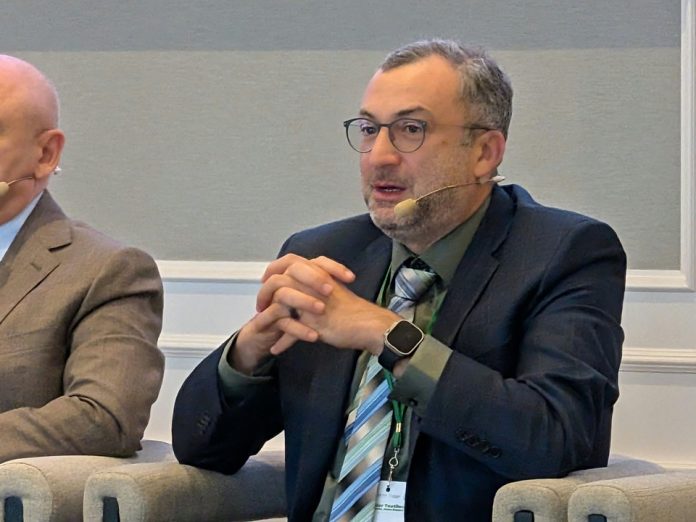
Romania could have an Extended Producer Responsibility (EPR) system for textiles in place by January 2028 if the sector manages to advance a functional legislative proposal by July 2027, Ionut Georgescu, CEO of FEPRA, said at the “Circular textiles. Less waste, more future” conference.
Georgescu said the current political situation makes it difficult to expect immediate progress from the government but argued that the textile industry and civil society should not wait for public authorities to initiate the process.
“Let’s be realistic. At the moment, we do not have a fully formed government. Once we have a full government, several more months will pass before we can actually have a text discussed with the government or a version of the text coming out of the Ministry of Environment based on the new government’s policy,” Georgescu said.
Despite the delays, he argued that Romania has a strong starting point for developing a competitive textile circularity system, given the country’s long-standing textile industry and existing expertise.
“Romania has had a textile industry for many years and has experience and skills in this area. I believe this could give us an exceptional starting point, not only for managing textile waste in Romania, but for the entire region,” he said.
Georgescu said Romania could develop significant capacity for textile reuse and recycling, while reducing reliance on energy recovery.
A major challenge, however, is deciding what the future system should actually prioritize and how recycling should be defined.
“We need to define what textile recycling means — upcycling, downcycling — and I would like us to be at the level of the countries we have seen in the European Union, with their targets and their level of development in sorting and collection,” Georgescu said.
He warned that Romania cannot simply replicate the ambitions of more advanced European markets without taking into account the country’s current administrative and infrastructure capacity.
“I would like to be there. But we live in Romania. We know very well the capabilities, the willingness and the involvement of the authorities,” he said.
According to Georgescu, shortcomings in environmental permitting, local authority capacity and funding for separate collection remain significant obstacles.
“We have been doing separate collection of textiles through local authorities for some time, but there is no money in the system, and, of course, the waste ends up where we do not want it to — including incineration,” he said.
He compared the situation to the development of other EPR systems in Romania, saying that the country has struggled to turn its ambitions into functioning circular economy infrastructure.
“I remember the years 2010-2012, when I was also dreaming with my eyes open about bringing European experience to Romania and creating a Romania where authorities, producers and recyclers would actually work together. Unfortunately, even after all these years — after 15 years — it still doesn’t work,” Georgescu said.
He warned that the textile sector could face a similar fate if it follows the same approach.
“If we continue to dream with our eyes open in the textile sector, I believe we could spend another 15 years with the same results as in packaging and WEEE,” he said.
Georgescu also proposed a concrete timetable for the sector to move from discussion to legislation.
He said stakeholders already have the expertise, public affairs capabilities and industry associations needed to take a legislative proposal directly to Parliament.
“Let’s demonstrate to the state that a complete system can be built from end to end. We can create a timetable in which the legislative text goes to Parliament,” he said.
He argued that the industry should not necessarily wait for the government to draft the legislation.
“We have public affairs, we have corporations, we have companies with public affairs experience, we have associations that can go to Parliament with the text. Today,” Georgescu said.
The proposed timeline is a functional legislative text by July 1, 2027, followed by implementation of a textile EPR system by January 1, 2028.
“If we want to have an EPR system in place by January 1, 2028, we need to have the legislative text by July 1. Today is October 7. Can we put that on the calendar? Realistically, can we have a functional legislative text by July 1?” he asked.
Georgescu acknowledged that the industry will not reach unanimity on every aspect of the future system. Stakeholders may have fundamentally different views on the number of EPR organizations, recyclers or the balance between public and private operators. But he argued that full consensus is not necessary to make progress.
His conclusion was that the sector should focus on finding a workable majority and moving forward rather than waiting for everyone to agree.