

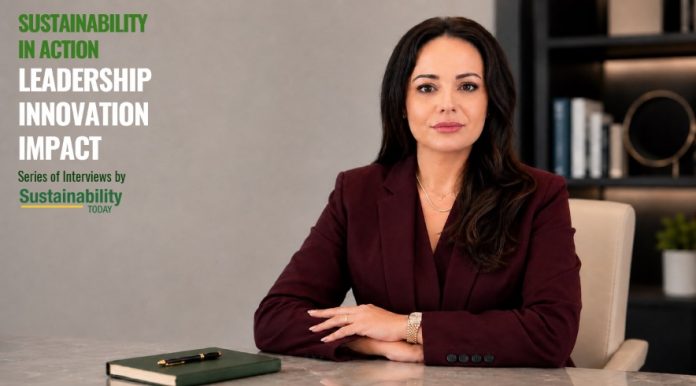
In the new editorial series of interviews, Sustainability in Action – Leaders’ Innovation Impact, Sustainability Today invites leaders in business to participate in an interview celebrating excellence in sustainability leadership across sectors. This editorial initiative recognizes organizations, projects, and individuals who demonstrate outstanding leadership, innovation, and measurable impact in advancing sustainable practices.
Find below the latest Interview with Denise Deleanu, COO Reciclad’OR, detailing on the strategic priorities this year, the breakthrough endeavors, challenges and impact of new technologies and positioning within the market landscape in Romania.
1.The market for extended producer responsibility transfer is constantly evolving, with increasingly strict regulations and rising expectations from producers and importers. What are Reciclad’OR’s strategic priorities for 2026, and how are they shaping your service portfolio and approach to client relationships?
The future of Extended Producer Responsibility is no longer about managing waste more efficiently. It is about helping businesses design a future where less waste is created in the first place. The Romanian OIREP market reached 648 million lei in 2025- a 10% increase on the prior year, driven not by enthusiasm but by legal pressure. Stricter recycling targets, PPWR implementation and increased traceability requirements are fundamentally changing what companies need from a compliance partner.
Our first priority for 2026 is to provide certainty. Selecting an OIREP is no longer an administrative procurement exercise. It is a strategic business decision. Since our establishment, Reciclad’OR has managed more than 1.5 million tones of packaging waste and today supports over 1,200 companies across Romania. Behind these figures stands a team of 30 specialists- the largest dedicated team in the Romanian OIREP sector.
In a market where some organizations operate with fewer than six employees, that capacity is not a detail. It is the infrastructure that makes consistent, traceable delivery possible.
Our ambition extends well beyond compliance. Companies are asking different questions now: how will PPWR influence packaging choices? How should sustainability objectives integrate into business strategy? These are questions about transformation- and that is precisely where we want to be.
2. As an OIREP, innovation is measured by how effectively you manage clients’ recycling obligations. Can you describe a project or approach that has made a tangible difference- whether in collection and recycling rates, or in the added value delivered to clients compared to standard market offerings?
Innovation is often associated with technology. In our sector, its real value lies in helping companies make better decisions before change becomes mandatory.
Our philosophy is simple: preparation creates competitive advantage.
For several years, Reciclad’OR has invested heavily in knowledge transfer. We have organized more than 50 specialized workshops covering EPR, PPWR and sustainability reporting, reaching almost 500 professionals from around 200 companies. Our objective has never been to explain legislation for its own sake- it is to translate complex regulation into practical decisions.
The national results put this in perspective. Romania’s national packaging recycling rate stands at 37.3% against a 2030 target of 65%- and its overall waste recycling rate is just 12.4%, the lowest in the EU. Closing that gap requires investment, verified recycling chains and partners with real operational depth.
Innovation, for us, means creating an ecosystem where expertise, operational excellence and digitalization work together to generate measurable environmental impact- and give companies greater confidence in every decision they make.
3. Transparency with clients is essential in a sector where legal compliance is the core stake. How does Reciclad’OR communicate recycling performance and impact to its producer and importer partners, and which reporting tools have proven most effective in building long-term trust?
In our industry, trust is not built through promises. It is built through transparency, consistency and evidence. When producers transfer their legal responsibilities to an OIREP, they are transferring an important element of business risk. They need to know that every obligation is managed accurately and every result is supported by reliable documentation.
Our role goes beyond reporting figures. A concrete example: when PPWR introduced the Declaration of Conformity requirement- coming into force in August 2026- we were already briefing clients on the practical implications for their specific packaging portfolios, before they knew to ask.
To support this, we built SustainabilityPRO.ro– a platform exclusively for Reciclad’OR partners. Daily updated legislation, practical guides, interactive tools including recyclability calculators and financial impact models, an AI consultant and a marketplace of packaging solutions. Not a static library. A living intelligence layer that transforms regulatory complexity into strategic decisions.
Long-term trust is ultimately built through the quality of the relationship- open communication, timely advice and the confidence that clients can rely on experienced professionals whenever new challenges arise.
4. What role does technology and digitalization play in Reciclad’OR’s service offering- from waste stream monitoring and regulatory reporting to client experience and operational efficiency?
Technology creates value when it reduces complexity and enables better decisions.
At Reciclad’OR, digitalization is embedded across our operating model. Solutions such as e-Reciclare.ro and SustainabilityPRO.ro simplify compliance and give partners easier access to information and guidance.
But the convergence of PPWR, CSRD and EPR obligations is creating a new challenge: companies are now reporting across multiple sustainability frameworks simultaneously, with overlapping data requirements.
Our direction is a single integrated ecosystem- where packaging obligations are managed, recycling performance is tracked, and data feeds directly into broader sustainability reporting. One partner, one platform, one point of accountability.
Technology is the infrastructure. Expertise is what makes it meaningful.
5. Looking ahead, which legislative and market trends will most significantly reshape the OIREP sector in Romania over the next few years, and how is Reciclad’OR positioning itself to respond to these changes in a way that benefits its clients?
The next few years will bring a significant transformation of the OIREP sector. The gradual implementation of PPWR will be one of the main drivers, alongside increasing requirements related to recyclability, recycled content, traceability, data quality and sustainability reporting.
These developments will redefine the role of EPR. Companies will increasingly need partners who combine operational reliability, regulatory expertise and the ability to anticipate change.
The choice of an OIREP is becoming a strategic business decision. Producers and importers need confidence that their compliance responsibilities are managed by organizations with the necessary expertise, infrastructure and long-term perspective.
At Reciclad’OR, we are preparing for this evolution by continuing to invest in people, technology, partnerships and knowledge. Our responsibility is to provide stability and predictability in a rapidly changing environment, ensuring that every obligation entrusted to us is managed professionally and transparently.
Ultimately, compliance is the foundation. The broader opportunity is to help companies build more resilient circular business models, where environmental responsibility becomes a driver of innovation, efficiency and long-term competitiveness.
The companies that will define the next decade of the circular economy will not be those that wait for regulation to force change, but those that have the vision to lead it. At Reciclad’OR, that is the future we are preparing for, together with our partners.