

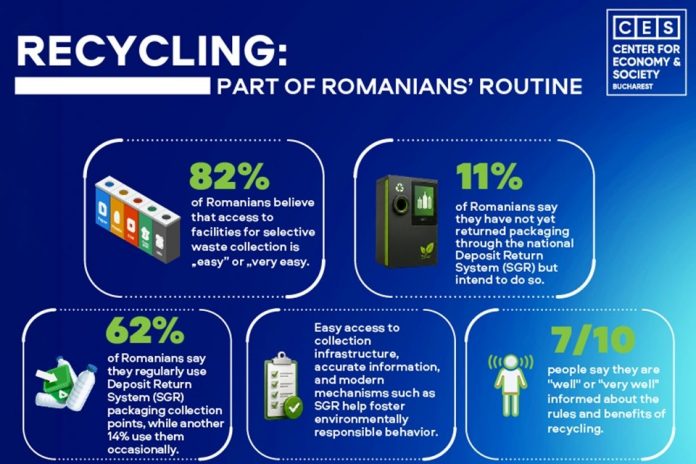
Romanians are taking concrete steps toward sustainable behavior, and recycling is becoming an increasingly accessible and common practice. According to a survey by the Bucharest Center For Economy & Society (CES Bucharest), the majority of the population reports having easy access to waste collection infrastructure and being well-informed about recycling rules.
The data show that 82% of respondents consider access to recycling facilities to be „easy” or „very easy” (56% easy, 26% very easy). Only 14% of Romanians report encountering difficulties, which indicates a significant improvement in infrastructure and the availability of recycling points nationwide.
Nationwide, in major cities such as Cluj-Napoca, Brașov, Timișoara, Constanța, and Oradea, more than 30 million euros have been invested in recent years in infrastructure for selective waste collection, according to public data.
Romanians not only have access to recycling, but they also understand its importance. 74% of study participants say they are „well” or „very well” informed about the rules and benefits of recycling (44% very well, 30% well). This high level of awareness supports the adoption of responsible behaviors in the long term. Only 19% of Romanians say they are very poorly informed or not informed at all.
Recycling is no longer perceived as a chore, but as a natural part of daily life, supported by infrastructure and information. This is an important moment for accelerating the transition to a circular economy.
Another strong indicator of this shift in attitude is the use of the national Deposit Return System (SGR). 62% of respondents say they regularly use packaging return points, while another 14% use them occasionally. In addition, 11% of Romanians say they have not yet tried the system but intend to do so, indicating potential for growth in the near future. Only 6% of survey participants say they have never tried returning packaging through the SGR and do not intend to do so.
The study’s results confirm a clear trend: recycling is becoming part of Romanians’ daily routine. Easy access to collection infrastructure, accurate information, and modern mechanisms such as SGR help foster environmentally responsible behavior.
The perception survey was conducted by CURS – the Center for Urban and Regional Sociology for CES Bucharest between December 10 and 19, 2025, among the adult resident population of Romania, based on a sample of 1,067 respondents, with a margin of error of + / – 3% at a 95% confidence level.