

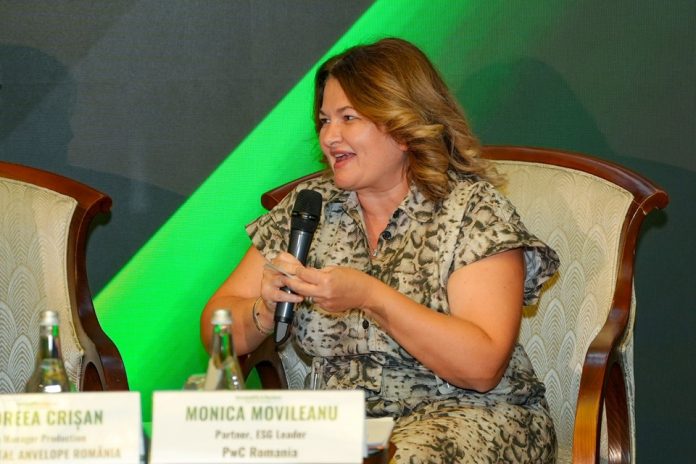
Companies are increasingly approaching sustainability reporting, but the quality of their disclosures often reflects whether they see sustainability as a strategic priority or merely a regulatory requirement, according to Monica Movileanu, Partner and ESG Leader at PwC Romania.
“We have companies that see value in sustainability, and we have companies that simply tick the box to ensure compliance. This is reflected in their reporting,” Movileanu said.
Companies that approach sustainability solely as a compliance exercise are particularly vulnerable when it comes to double materiality assessments, she explained, highlighting four major areas that require greater attention: stakeholder engagement, data collection and internal controls, EU Taxonomy reporting, and credible climate transition plans.
One of the main challenges is ensuring that stakeholders understand the purpose of double materiality assessments and are meaningfully involved in the process.
Movileanu also highlighted the importance of involving finance professionals in sustainability strategy and reporting, rather than treating sustainability as an isolated function.
“How do you explain to your accountant the value of sustainability and the role they play in implementing it, if they are not consulted at every step on the strategy, the double materiality assessment and what can be included in the sustainability report?” she asked.
The problem extends beyond internal teams to external stakeholders, who may not be adequately consulted or informed about what double materiality means and how it could affect them.
“The biggest challenge comes from double materiality, because stakeholders are not consulted and are not given an explanation of what double materiality means and how it may or may not affect them,” Movileanu said.
The second major challenge is data management, particularly the lack of integrated collection systems and robust internal controls.
“Data is everywhere and nowhere, yet we still lack internal controls and the involvement of the finance function. We have one person entering the data into Excel,” Movileanu said.
Very few companies have invested in integrated systems for collecting sustainability data, she noted. In organisations with larger finance teams, responsibilities can be separated between employees who enter information and those who review it. However, this safeguard is often absent in smaller businesses.
“In many companies, there are only one or two employees, so they collect the data, but there is no longer a verification system. This makes data collection the most vulnerable area,” she explained.
The lack of reliable systems and review procedures can undermine the quality and credibility of sustainability disclosures, making stronger internal controls an important priority for companies preparing their reports.
The EU Taxonomy is another area where companies face substantial difficulties, according to Movileanu. These include limited understanding of the framework, insufficient reconciliation with financial information and confusion between eligible and aligned economic activities.
“The third priority area is the Taxonomy, which nobody seems to understand, which does not reconcile properly with the financial side, and where companies fail to distinguish between eligible and aligned activities,” she said.
She also pointed to a lack of sufficient evidence to substantiate claims that activities are aligned with the Taxonomy criteria.
For companies, this means that reporting should go beyond identifying potentially relevant activities and ensure that claims of alignment are supported by appropriate documentation and evidence.
A fourth challenge concerns climate transition planning and decarbonisation strategies. Although many sustainability reports contain ambitious climate commitments, the practical steps required to achieve them are often insufficiently explained.
“Paper will take anything. We put all sorts of things in there about what we are going to do, but there is a significant gap between management’s ambition to achieve a net-zero commitment by 2050 and the actual pathway to get there,” Movileanu said.
She noted that sustainability reports frequently state long-term ambitions without clearly setting out the milestones, actions and feasibility assessments needed to achieve them.
“How do we get there? What are the steps? Is it realistic or not? Very few companies disclose this,” she said.
For manufacturing companies in particular, credible decarbonisation strategies must be developed with operational teams rather than designed exclusively at management level.
“A decarbonisation strategy does not start in an office; it starts in operations. It is not something that sits solely with top management. It starts with discussions with the people working in production, on the factory floor,” Movileanu explained.
Production processes are a major source of corporate emissions, making operational transformation essential to achieving meaningful climate progress.
“Globally, around a quarter of emissions come from production. If we also include energy consumption, the share becomes even higher. This is not necessarily a problem; it is a major area of opportunity,” she said.
Movileanu concluded that climate transition in the industrial sector cannot be achieved through reporting commitments alone. Companies need to translate their climate ambitions into substantial changes in how their operations function.
“To achieve this climate transition in production, we need an operational transition — a significant operational transformation,” she said.