

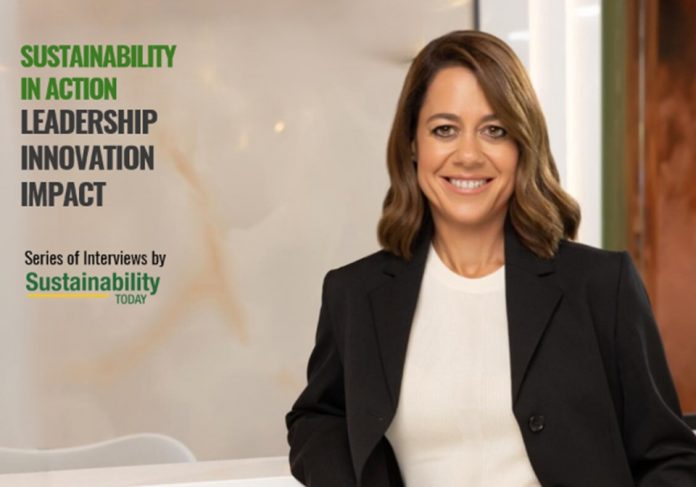
In the new editorial series of interviews, Sustainability in Action – Leaders’ Innovation Impact, Sustainability Today invites leaders in business to participate in an interview celebrating excellence in sustainability leadership across sectors. This editorial initiative recognizes organizations, projects, and individuals who demonstrate outstanding leadership, innovation, and measurable impact in advancing sustainable practices.
Find below the latest Interview with Ioanna Christopoulou, General Manager L’Oreal Romania, detailing on the strategic priorities this year, the breakthrough endeavors, challenges and impact of new technologies and positioning within the market landscape in Romania.
Q1. As sustainability priorities continue to evolve, what are the key strategic sustainability goals and leadership priorities for your organization in 2026, and how are they shaping business decisions across the organization?
For L’Oréal Romania, 2026 is the year of the refill revolution. And this is a strategic battle, as we see a gap between what consumers say and what they do. While most consumers say they want to buy more sustainably and online conversation about beauty refills continues to grow, the gap between intention and action remains significant.
As a market leader, our absolute priority is integrating sustainability directly into the business decision-making process. Our strategic priorities are guided by the scientific concept of “planetary boundaries” and focus heavily on accelerating the transition to a circular economy and achieving carbon neutrality at a local level.
How this translates in local business decision?
First, by shifting our portfolios to sustainable formats. Every product launch and commercial campaign is evaluated through the lens of its environmental impact. Our decision to prioritize refillable and eco-designed formats directly influences how we select retail partners and promote our brands. This year we went a step further and we have launched our most ambition campaign yet, #JoinTheRefillMovement, that aims to make refills the norm in beauty and help consumers understand the benefits of switching to refillable formats.
Secondly, by decarbonizing logistics and workplaces. Relocating our Bucharest headquarters to a state-of-the-art, highly energy-efficient building (U-Center) certified to the highest green standards reflects our commitment to reducing our direct operational footprint. Furthermore, logistical decisions are now driven by rigorous route optimization and greener transport solutions to reduce transport-related CO2 emissions.
Third, by being a force for good through active social responsibility. We believe economic success must go hand-in-hand with social progress. Therefore, supporting vulnerable local communities is a shared value embedded in our brands’ causes.
Q2. Can you share some of the sustainability projects and initiatives that best demonstrate innovation within your organization? What challenge was it designed to address, and what measurable environmental and social impacts has it achieved?
R&I plays a pivotal role in our sustainable transformation, driven by two interconnected pillars: green sciences and product eco-design. R&I plays a pivotal role in our sustainable transformation, driven by two interconnected pillars: green sciences and product eco-design. Globally, this means we are completely reinventing our formulas to rely on bio-sourced ingredients and using tech to minimize packaging. Locally in Romania, we’ve translated this eco-design pillar into a major environmental initiative with our #JoinTheRefillMovement campaign. We tackled the massive challenge of single-use plastics by introducing high-end refill systems for our mass market, luxury and professional lines, which actually reduce packaging weight and virgin plastic use by up to 70% for those products.
But our commitment to scientific innovation doesn’t stop with the environment; it has a profound social dimension as well. Because we believe science is the ultimate engine of progress, we’ve dedicated ourselves to empowering the local scientific community. Through the L’Oréal-UNESCO ‘For Women in Science’ national program, which has celebrated 15 years of impact in Romania, and awarded half a million RON in fellowships to brilliant young female researchers. For us, this is the ultimate circle of innovation: using green sciences to protect our planet, while actively funding and empowering the female scientists who will create the sustainable solutions of tomorrow.
Q3. How do you ensure that sustainability objectives are integrated into core business operations, governance, and long-term value creation rather than remaining standalone initiatives?
For over 25 years, L’Oréal has proactively worked towards a sustainable and inclusive future, seeking to protect the planet’s beauty and empowering communities worldwide. From opening the environmental research laboratory in 1995 to being among first one hundred companies to join the Science-Based Targets initiative (SBTi) in 2015, L’Oreal has a good record of long term, interconnected sustainable initiatives, rather that a series of standalone initiatives.
This path was intentional and, in order to embed sustainability into our corporate DNA, we make it a core KPI of everyone’s daily job.
We hold our leaders accountable. A portion of the performance bonuses of our top managers globally and locally is linked to meeting our concrete L’Oréal for the Future sustainability targets (carbon reduction, plastic reduction, solidarity sourcing).
We run intensive upskilling programs like “L’Oréal for the Future” masterclasses for 100% of our Romanian employees. When a marketer, logistics manager, or sales representative understands the exact impact of their daily business decisions, their behavior changes naturally.
We run local solidarity days, Citizen day, where employees physically go out to plant forests, clean up beaches, or support local disadvantaged communities. Hands-on experience creates emotional connection.
We make bold choices, like moving our offices from the North after 25 years in the area to the center-south in the most sustainable office building in Romania today, to ensure our environmental footprint linked to our operational sites stays as low as possible.
Q4. Effective communication is essential for driving engagement and accountability. How does your organization communicate sustainability performance and impact to stakeholders, and what approaches have proven most effective in building trust and transparency?
In an era where consumers and authorities are increasingly vigilant about “greenwashing,” full transparency is the only way to build trust.
We are displaying precise, measurable impact savings directly on our packaging and campaigns. We tell the Romanian consumer exactly what they are saving when choosing refillable formats or renewed packages and products.
We pioneered an A-to-E environmental scoring system (backed by independent scientific auditors) for products like Garnier and La Roche-Posay. This grades the product’s footprint (water, carbon, packaging) so consumers can make fully informed choices at the shelf, completely eliminating vague or misleading “green” claims.
We enforce 100% transparency across our massive supply chain by requiring all packaging and raw material suppliers to undergo rigorous independent third-party audits for their social and environmental impact.
Q5. What is the role of technology, digital solutions, and artificial intelligence in advancing your sustainability strategy, improving decision-making, or enhancing the measurement and management of sustainability performance?
As a Beauty Tech leader, technology and digital solutions are both accelerators and enablers of our sustainability strategy.
We use artificial intelligence and predictive algorithms in our global laboratories to design new formulas based on “Green Sciences.” AI helps us simulate the stability and efficacy of natural, bio-sourced ingredients before physical trials, drastically reducing resource consumption and waste during the early R&D phases.
Digitalizing our database enables our design teams to instantly calculate the carbon and environmental impact of any packaging modification, such as reducing bottle wall thickness or replacing virgin plastic caps with recycled materials. This data-driven agility allows us to make rapid, environmentally precise decisions.
In Romania, inventory management and logistics are optimized using planning algorithms. These tools allow us to minimize overstocks and preventing product waste. Furthermore, smart routing software helps us optimize local distribution, directly lowering transport-related carbon emissions.
Q6. Looking ahead, what emerging sustainability trends, innovations, or technologies do you believe will have the greatest influence on organizations seeking to create meaningful environmental and social impact over the next few years?
Looking to the future, we believe several emerging trends and technologies will redefine how organizations generate positive environmental and social impact.
The resource of the future will no longer be extracted from the earth but grown or synthesized through sustainable biological processes. Transitioning from traditional synthetic ingredients to bio-sourced alternatives will be a game-changer.
Preserving natural resources is rapidly becoming a critical global priority. Innovations in water loop factories or waterless formulas will significantly reduce water consumption during manufacturing and usage.
But this is only half the battle; we desperately need to address the ‘last mile’ of sustainability. Especially here in Romania, the real frontier is last-mile sorting and recycling. We can design the most sustainable, recyclable packaging in the world, but to actually close the loop, the local waste management and recycling systems have to work effectively. It cannot be done by one company alone, it takes a whole ecosystem of producers, retail partners, waste collectors, local authorities, and consumers working to drive real circularity.
Lastly, sustainability can no longer be viewed solely through environmental lenses. There is a powerful emerging trend recognizing the deep interdependency between environmental health and social equity. Organizations will increasingly be evaluated on how they protect human rights across their entire supply chains and how they actively support vulnerable communities most impacted by climate change.