

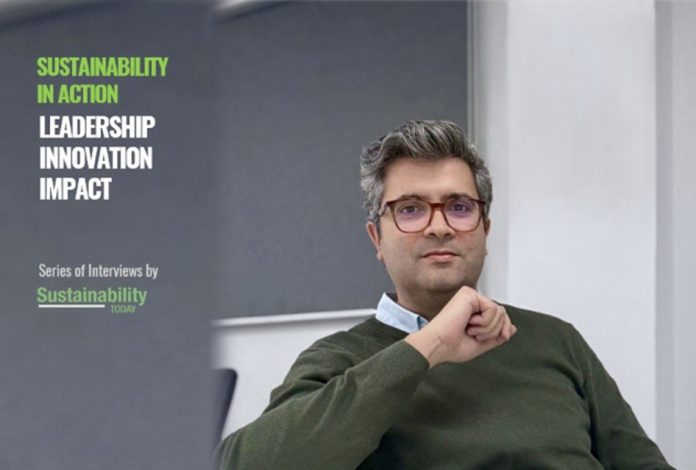
In the new editorial series of interviews, Sustainability in Action – Leaders’ Innovation Impact, Sustainability Today invites leaders in business to participate in an interview celebrating excellence in sustainability leadership across sectors. This editorial initiative recognizes organizations, projects, and individuals who demonstrate outstanding leadership, innovation, and measurable impact in advancing sustainable practices.
Find below the latest Interview with Marco Marques, Managing Director SEE at BA Glass, detailing on the strategic priorities this year, the breakthrough endeavors, challenges and impact of new technologies and positioning within the market landscape in Romania.
1. As sustainability priorities continue to evolve, what are the key strategic sustainability goals and leadership priorities for your organization in 2026, and how are they shaping business decisions across the organization?
For BA Glass, 2026 is a year of consolidation and proof, not new ambition-setting. With our Science Based Targets initiative (SBTi)-validated targets and CDP ‘A’ rating already in place, the priority now is demonstrating that these translate into real furnace-level performance and financing terms, not just reporting. Decarbonization of our furnace operations remains our single largest lever — glass melting is energy-intensive by nature, so every capital decision on furnace rebuilds is effectively a climate decision with a 10-15 year horizon, and increasingly, a financing one too, given our sustainability-linked financing structure.
The second priority is regulatory readiness: CSRD, EU ETS benchmark revisions, CBAM, and now Packaging and Packaging Waste Regulation (PPWR) are converging on our sector at once, and the compliance bar keeps rising. Sustainability is not managed as a separate agenda. It is embedded into our strategic planning, capital allocation and business decision-making processes, ensuring that environmental performance contributes directly to long-term competitiveness and value creation.
2. Share some of the sustainability projects and initiatives that best demonstrate innovation within your organization
I’ll highlight our increased use of recycled glass and participation in national glass collection platforms — less a single project than building the collection and cullet-quality infrastructure the whole industry depends on. Glass is infinitely recyclable, but only if the cullet reaching our furnaces is clean and available at scale. Being an active participant, not just a buyer of cullet, lets us influence how collection and sorting evolve in Europe — which directly improves our melting carbon intensity. As an example, we are now deeply involved in the extension of the Close the Glass Loop platform to Bulgaria, as is already the case in Romania.
On the customer side, we’ve worked with major FMCG brands through our “Collab2Zero” program to co-develop decarbonization roadmaps combining technology and energy pathways. These partnerships matter because our customers’ Scope 3 targets depend on our Scope 1 and 2 performance; the innovation is as much in the collaboration model as the technology. By combining expertise, technology and shared objectives, we create solutions that reduce emissions across the value chain while supporting customers in achieving their own sustainability targets. Another great example is the Lightweight projects with our customers, in these projects we pick a given model and make a similar design where the biggest change is a weight reduction, this means less CO2 emissions for the “same” bottle.
3. How do you ensure that sustainability objectives are integrated into core business operations, governance, and long-term value creation rather than remaining standalone initiatives?
The clearest structural signal is reporting line: sustainability reports directly to the Executive Committee, not buried under operations or communications. That means sustainability trade-offs are discussed at the same table as commercial and operational ones — there’s no translation layer where they get diluted before reaching decision-makers. We’ve also tied sustainability performance to financing terms through our sustainability-linked structure. When the cost of capital depends on hitting independently verified ESG KPIs, sustainability becomes a financial variable the whole organization has an interest in managing well.
Operationally, we’ve deliberately merged sustainability with continuous improvement methodology. In a hard-to-abate sector like glass, most decarbonization gains come from the same discipline that drives quality and efficiency — stability, waste reduction, process control. That framing has made it far easier to embed into daily plant-level decisions.
4. Effective communication is essential for driving engagement and accountability. How does your organization communicate sustainability performance and impact to stakeholders?
We communicate differently depending on the audience — that differentiation is itself key to building trust and for us trust is built through transparency, consistency and measurable results.
With customers, transparency means being specific and quantified: sharing our actual decarbonization roadmap rather than aspirational statements. Credibility comes from technical depth and consistency over time, not marketing language.
Externally, our CDP ‘A’ rating and third-party verified SBTi targets do much of the trust-building for us — independently verified numbers carry more weight than any narrative we could write ourselves.
Internally, engaging plant-level teams directly, rather than issuing top-down targets, is what drives accountability; people trust and act on commitments they helped shape and understand. That same principle — putting good data directly into the hands of the people running the process will generate the value.
5. What is the role of technology, digital solutions, and artificial intelligence in advancing your sustainability strategy?
Technology and digitalization are becoming increasingly important drivers of sustainability in glass manufacturing.
In glass manufacturing, the single biggest environmental lever is the glass furnace: the furnace accounts for the large majority of our energy consumption and direct emissions. That is where we have concentrated our digital and AI efforts; in our industry, sustainability and operational excellence are largely the same problem: every improvement in energy efficiency, stability or yield translates directly into a carbon improvement.
The following three examples illustrate this approach. First, we have deployed closed-loop furnace control (“autopilot”) at several plants, using automated decision-making models to keep furnaces running in a stable, energy-efficient regime around the clock, rather than depending on individual operator skill and shift-to-shift variation. Stability is the foundation of efficiency: a furnace that runs steadily consumes less energy per tonne of glass produced. Second, we use data-driven recipe and batch optimisation across plants to maximise the use of recycled glass (cullet) and optimise raw material composition. Cullet requires significantly less energy to melt than virgin raw materials, so this is both a circularity and a decarbonisation measure. Third, advanced quality analytics help us reduce defects and rejected production; every container we don’t have to remelt is energy and material we don’t waste.
One lesson worth sharing: the technology is the easier half. The value only materialises when the people on the shop floor trust and use these tools daily, which is why we invest deliberately in digital training for operators and supervisors, not just for data teams. AI and digitalisation in sustainability are not a moonshot for us; it is the compounding effect of making the efficient way of operating the default way of operating.
6. Looking ahead, what sustainability trends, innovations, or technologies will have the greatest influence on organizations seeking to create meaningful impact?
For energy-intensive industries like ours, the defining trend of the next few years is the decarbonization. In container glass, this means the transition from current conventional solutions towards renewable gases like Biomethane and a different degree of electrification. These are long-cycle investments so the decisions being made now will determine the industry’s emissions profile well into the 2040s. The organisations that navigate this best will be those that treat it as an engineering and data problem, not only a capital allocation one: you need deep understanding of your own process to know which technology fits which asset.
The second trend is the maturing of circularity infrastructure. Glass is infinitely recyclable, but the limiting factor has never been the material; it is collection and quality. For us, every additional point of cullet in the batch is a direct energy and carbon saving, so policy and infrastructure developments outside our factory gates will have as much impact as anything we do inside them.
Third, I expect AI in industry to move from assisting decisions to increasingly making them; from advisory dashboards to closed-loop systems that continuously optimise energy, quality and throughput within safe boundaries. We are already testing these concepts (as answered above). Combined with much more granular carbon data, this changes sustainability management from an annual reporting exercise into a real-time operational discipline: emissions become a process variable you steer, like temperature or pressure.
The organisations that create meaningful impact will be the ones that connect these three threads: new melting technology, circular material flows, and autonomous optimisation rather than pursuing any one of them in isolation.