

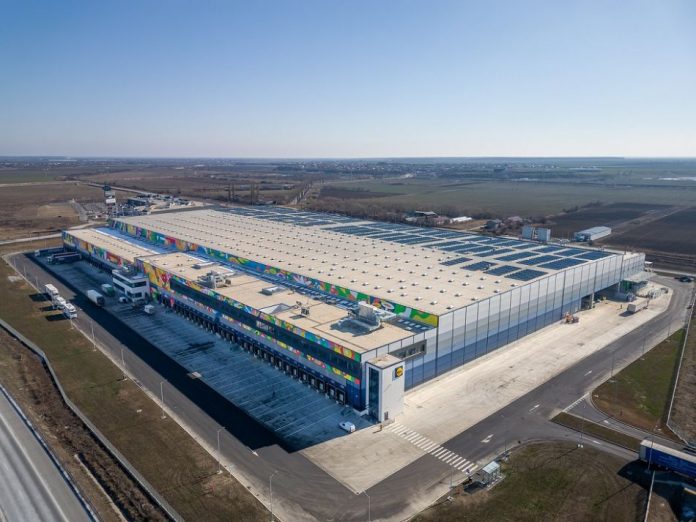
Lidl Romania has published its latest sustainability report, covering the 2024 financial year, announcing accelerated progress in reducing the company’s environmental impact. The retailer has already met its international 2030 target for transitioning to natural refrigerants—now used in 100% of its logistics centers and 81.7% of its stores, compared to the initial goal of 100% of logistics centers and 40% of stores. Additionally, the company has increased its share of green energy to 80% of its total electricity consumption.
Lidl Romania is continuing to expand its investments in sustainable infrastructure, equipping 108 stores and two logistics centers with photovoltaic panels and building new stores exclusively certified under the EDGE green building standard. The retailer has also strengthened partnerships with more than 540 local producers, bringing the total number of Romanian-sourced products in its assortment to 4,366. These results highlight the company’s commitment to embedding sustainability across its operational model, contributing to efficiency, resilience, and accessibility for customers and partners.
One of the major milestones achieved is the transition to natural refrigerants. Initially set as a global Schwarz Group goal for 2030—100% of logistics centers and 40% of stores—this objective has already been surpassed in Romania. Currently, 100% of Lidl Romania’s logistics centers and 81.7% of its stores are equipped with systems using only natural refrigerants. This transition has a direct, positive impact on emission reductions and supports the modernization and efficiency of retail operations.
“Achieving ahead of schedule the transition to natural refrigerants is one of our most important accomplishments, as it has a direct and measurable effect on reducing emissions. It is the result of years of consistent investment in efficiency, modernization, and technologies with lower environmental impact. Throughout this journey, we have learned that real progress comes when sustainability is integrated into every operational decision—whether we are talking about green energy, photovoltaic infrastructure, or long-term collaborations with local suppliers. We remain focused on the future and will continue accelerating projects that strengthen the company’s resilience and bring tangible benefits to communities, the environment, and our customers,” said Maria Mihai, Head of Corporate Affairs at Lidl Romania.
Advancements in Energy, Climate, and Infrastructure
The retailer’s progress is also reflected in continuous investments in renewable energy. In 2024, 80% of the electricity used by Lidl Romania came from green sources, while the photovoltaic systems installed in 108 stores and two logistics centers generated 4.9 million kWh of electricity internally. The company’s network now includes 381 electric vehicle charging points available to customers in store parking lots.
Regarding greenhouse gas emissions, Lidl Romania contributes to the Schwarz Group’s collective goal of reaching Net Zero emissions by 2050, in line with Science Based Targets initiative (SBTi) criteria. Aligned with Lidl’s global target of reducing Scope 1 and Scope 2 emissions by 70% by 2030 compared to 2019 levels, Lidl Romania has set an even more ambitious local goal: an 80% reduction in its Scope 1 and Scope 2 emissions by 2030.