

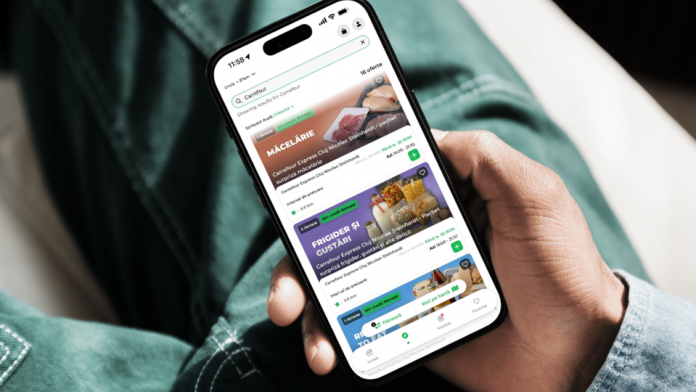
More than 1.1 million food packages have been saved from going to waste in Romania through Bonapp since the app was launched. These are products that are still perfectly good to eat but risk remaining unsold and ultimately being thrown away, including items approaching their use-by date, surplus products from retailers, or food prepared during the day by restaurants and bakeries that has not been sold.
Through Bonapp, businesses can offer these products to consumers instead of throwing them away, typically at discounts ranging from 50% to 70%. In almost five years, Romanians have saved more than RON 14.5 million this way, turning what could have become food waste into more than 1.1 million packages purchased and consumed.
Globally, approximately one-third of all food produced goes to waste. In Romania, this amounts to 181 kg of food waste per person per year, one of the highest levels in the European Union. Approximately 31 kg comes from retail, restaurants and food services – precisely the part of the food chain where Bonapp intervenes before food that is still perfectly good to eat becomes waste.
Food rescue through Bonapp started in Bucharest on November 4, 2021. Since then, the app has expanded to 144 cities across Romania, with more than 2,000 restaurants, bakeries and retailers joining the platform, including major brands such as PENNY, Carrefour, Starbucks and Ana Pan.
Mixed food packages are the most frequently rescued category, accounting for 35% of all packages saved, followed by desserts at 21% and prepared meals, also at 21%. Preferences vary significantly from one city to another. Desserts dominate in Cluj-Napoca, where they represent 39% of all food rescued, and in Iași, at 35%. In Arad, mixed food packages account for 94% of all packages rescued.
Ordering times also differ significantly across cities. In Arad, orders peak in the morning at 8:00 a.m. At the other end of the spectrum is Iași, where orders peak at 8:00 p.m. Nationwide, evenings account for the highest volume of orders: each hour between 5:00 p.m. and 8:00 p.m. represents between 7% and 8% of total orders, making Romania the latest-ordering market among the four countries in which the app operates.
Relative to population, Cluj-Napoca is Bonapp’s strongest city in Romania. The number of packages rescued per 1,000 inhabitants is 50% higher there than in Bucharest, although the capital remains by far the leader in absolute numbers. Iași ranks third on a per-capita basis.
One customer has been with Bonapp almost since the beginning. In nearly five years, this customer has rescued 4,027 packages, all in the same city.
The country’s largest food rescuer is a supermarket: a PENNY store in Bucharest’s Titan neighborhood. The largest independent food rescuer is Artizanii by Demetra Organic Bakery on Drumețului Street, also in Bucharest, which has sold 17,986 packages through 8,362 orders since October 2022 and remains active on the platform today.
In Romania, thanks to Bonapp’s customers and partners, approximately 922 tonnes of food have been prevented from going to waste.* All this food had already been grown, produced, prepared or transported before reaching the shelf. Through Bonapp, instead of becoming waste, it was consumed.
“Almost five years ago, when we launched Bonapp, we still had to explain why there was nothing wrong with buying food at a lower price that would otherwise risk being thrown away. Today, more than 1.1 million rescued packages later, saving food has become a habit for a growing number of Romanians. For us, that is the most important change: we are not only saving food, we are helping change the way people think about food waste,” said Luka Zivkovic, co-founder of Bonapp and General Manager for Romania, Czechia and Slovakia within Munch Group.