
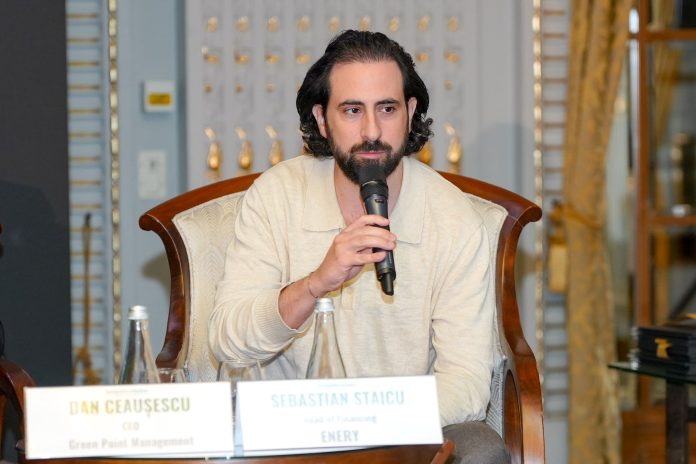
Enery’s sustainable financing framework is designed to open doors to investors with capital dedicated to sustainable assets, though it does not automatically secure better financing terms, Sebastian Staicu, Head of Financing at Enery, said during the Sustainability in Business Forum, organised by Sustainability Today and The Diplomat-Bucharest.
“At the beginning of the year, we published a sustainable financing framework, which has received a rating from Fitch and aims to make it easier to access certain pools of capital when going to the capital markets,” Staicu said.
The framework covers several financing instruments, including bonds and equity.
“There are certain pools of capital in the world whose purpose is to finance everything related to sustainability. This framework simply puts on paper and confirms our internal discipline in assessing whether our investments are sustainable according to certain European and international methodologies,” he explained.
“It is a very pragmatic matter. There is nothing aspirational about this sustainable financing framework,” he said.
No shortcut to cheaper bank loans
According to Staicu, a sustainable financing framework does not automatically translate into preferential lending terms from banks, although it can facilitate dialogue with investors in capital markets who have dedicated allocations for sustainable investments.
Before joining Enery, Staicu worked in banking, where companies frequently asked whether adopting such a framework would earn them better terms from lenders. Banks may focus on sustainable investments, he said, but he was not aware of them setting aside separate funds for them.
Capital markets are a different story.
“In the capital markets, there are dedicated pools of capital, and companies that may aspire to access these markets at some point can approach those investors and have an easier dialogue,” Staicu noted.
Still, he cautioned that the framework is no substitute for strong fundamentals.
“Obviously, it does not replace the discussion about the profitability of your business, nor does it replace any other discussion. But it may make the dialogue easier because you have this instrument, and the pool of capital is dedicated to sustainable financing,” he said.
Solar panels, beehives and fruit crops
Enery’s commitment to sustainability, however, goes beyond the framework itself.
“At Enery, we are trying to do a little more than that: to demonstrate our commitment to this topic through the other things we do, allocating budgets from our operating expenditure every year for each investment,” Staicu said.
One area of focus is agrivoltaics: combining solar power generation with farming on the land around and beneath the photovoltaic panels.
“We are trying to see how we can combine the idea of agriculture with renewable energy production,” he said.
The company has also launched biodiversity initiatives at some of its sites, like for example: installing beehives within the solar parks, introducing sheep to gaze the grass onsite, using smart technologies to measure and assess the biodiversity.
Enery also plans to test fruit crops beneath the panels at a large hybrid project combining photovoltaic generation and battery storage.
“At the beginning of this year, we launched the construction of Ogrezeni project, which is set to be Europe’s largest hybrid park, combining photovoltaics (761 MWp) and battery storage (1 GWh storage). We are also trying to determine to what extent we can plant certain fruit crops there that do not require as much sunlight and can grow beneath the panels,” he said.