

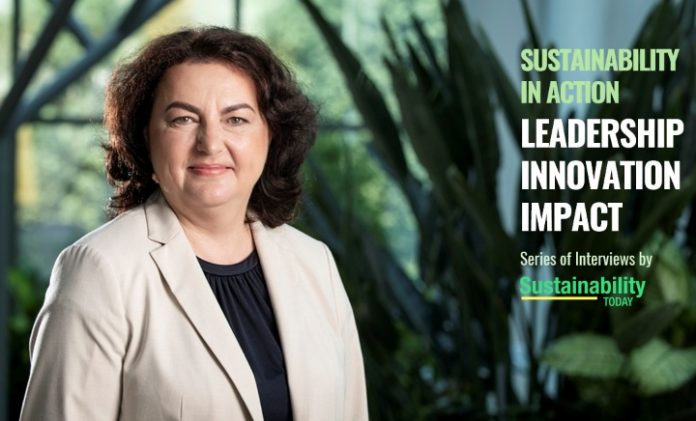
In the new editorial series of interviews, Sustainability in Action – Leaders’ Innovation Impact, Sustainability Today invites leaders in business to participate in an interview celebrating excellence in sustainability leadership across sectors. This editorial initiative recognizes organizations, projects, and individuals who demonstrate outstanding leadership, innovation, and measurable impact in advancing sustainable practices.
Find below the latest Interview with Diana Pavel, Environmental Director, Transavia, detailing on the strategic priorities this year, the breakthrough endeavors, challenges and impact of new technologies and positioning within the market landscape in Romania.
1. As sustainability priorities continue to evolve, what are the key strategic sustainability goals and leadership priorities for your organization in 2026, and how are they shaping business decisions across the organization?
At TRANSAVIA, sustainability is not a parallel agenda, nor an end goal. It is part of how we make business decisions every day because when you own every step of the production chain, you cannot transfer responsibility to someone else. You are accountable for the quality of the food, the welfare of the animals, the resources you consume, the people you employ and the communities where you operate. So, it is natural that our ESG priorities are not separate from our business strategy and definitely, not a compliance exercise. For more than 35 years, we have built our family business around one simple principle: doing things the right way, from grain to fork. Because we understood form the very beginning that sustainability is not about ticking boxes or reporting, but it is about earning people’s trust every single day. Through safe, high-quality food, responsible stewardship of natural resources, a zero-waste mindset, respect for our people, partners and communities, and long-term investments in production capacity, renewable energy, resource efficiency, circularity and climate resilience, we create lasting value wherever we operate.
In 2026, our ambition remains unchanged to consistently doing the right things, from grain to fork: to strengthen the trust people place in our company and our products by consistently doing what we have always done: delivering safe, high-quality food while creating long-term value for people, communities and the environment.
2. Can you share some of the sustainability projects and initiatives that best demonstrate innovation within your organization? What challenge was it designed to address, and what measurable environmental and social impacts has it achieved?
At TRANSAVIA, innovation is measured not by how many or what kind of new technologies we implement, but by how much value they create for consumers and customers. Our ambition has always been to deliver sustainable, safe, high-quality food people can trust, while continuously improving the way we operate, from grain to fork. A good example is how we reshape Romania’s fresh poultry category by extending the shelf life of fresh products through innovative processes and technology, setting new expectations for freshness, a couple a decades ago. We continue to invest in more sustainable packaging solutions and in Modified Atmosphere Packaging (MAP), which extends product freshness and shelf life, helping retailers and consumers reduce food waste without compromising food safety or quality. We have also made the largest investment in renewable energy in the Romanian food industry, increasing our energy independence while reducing emissions and strengthening the resilience of our operations. We have often chosen to move before the market or regulation required us to. We were the first company in Romania’s food industry to publish a Sustainability Report voluntarily, back in 2019, because we believed transparency should be earned, not imposed. Today, we continue that journey through our first ESRS Sustainability Report, with clearer targets and greater accountability.
Perhaps the best example of innovation is our fully integrated “grain-to-fork” model. By owning every stage of the value chain, we have been able to embed circularity into the way we operate, making it an integral part of our business rather than a standalone sustainability initiative. We do not see waste as the end of a process, but as a resource with the potential to create value elsewhere in the production cycle. By design, the cereals grown on our farms are transformed into feed in our own feed mill, while straw and other crop residues return to our poultry farms as bedding. After use, the bedding mixed with poultry manure is processed into organic fertilizer that is applied back to our fields, helping improve soil fertility and supporting future harvests. Likewise, by-products from poultry processing are recovered in our state-of-the-art protein meal plants and transformed into valuable raw materials for other industries. This sustainable approach allows us to recover more than 99.4% of the by-products generated across our operations, significantly reducing the environmental impact. Additionally, wastewater is treated in our own treatment facilities and the resulting sludge is responsibly recovered for agricultural use. This closed-loop approach allows us to extend the life of resources, minimize waste and maximize efficiency across the entire value chain, creating long-term business value because, in practice, very little becomes waste because almost everything is designed to become a valuable input for another process.
But our responsibility does not end when a product leaves our facilities. It extends throughout the entire value chain, including the way our products are transported, stored, sold and ultimately consumed. By optimizing logistics, eliminating unnecessary transport, extending product freshness, helping reduce food waste and encouraging responsible consumption, we aim to minimize environmental impact at every stage. Sustainability delivers its greatest impact when everyone across the value chain, producers, retailers and consumers, plays their part in making the best possible use of every resource.
3. How do you ensure that sustainability objectives are integrated into core business operations, governance, and long-term value creation rather than remaining standalone initiatives?
At TRANSAVIA, doing things the right way is not just a tag line, but it is how the business was designed from the very beginning. Long before sustainability became a bubble word or a regulatory request priority or a reporting framework, our integrated “grain-to-fork” model was built around taking responsibility for every stage of the value chain. When you build and run a business this way, sustainability cannot belong to a single department, but it is everyone’s responsibility. Agriculture, feed production, farming, processing, logistics, procurement, quality, finance, IT, marketing and senior management all contribute to the same objective: making better decisions that gain people’s trust, improve product quality, food safety, operational efficiency, and financial and environmental performance at the same time. Therfore, the sustainability benefits are not separate outcomes, but they are the natural consequence of operating the business responsibly.
Our integrated model also enables us to measure what matters. We continuously monitor energy, water, waste, emissions and operational performance, because data alone creates no value. Value comes from understanding that data, making better decisions and continuously improving the way we operate.
For us, sustainability is not measured by the number of ESG initiatives we report, but by our ability to consistently deliver trustful, safe, high-quality food while creating lasting value for consumers, customers, employees, communities and the environment.
4. Effective communication is essential for driving engagement and accountability. How does your organization communicate sustainability performance and impact to stakeholders, and what approaches have proven most effective in building trust and transparency?
Trust is never built through communication alone, but earned every day by doing things right and communicating them honestly. At TRANSAVIA, transparency is not a reporting exercise or a communication strategy, but it is a management principle built on one simple idea: we walk the talk by aligning our actions, our results and our communication, because credibility is built through consistency, not promises. This principle guides everything we do, from the simple, clean information we place on our product labels to the way we report our environmental, social and governance performance. That is also why we do not rely on marketing shortcuts or claims that cannot be substantiated. Whether someone reads one of our product labels or our Sustainability Report, they should find the same thing: clear information, measurable facts and honest communication. Consumers deserve clear, relevant information about what a product is, rather than claims about what it is not or claims that distract them from what is truly relevant to their decision. Just as customers, our partners and other stakeholders deserve a transparent view of how we operate and the impact we create.
Being transparent also means communicating with the same level of honesty and respect to everyone we work with: our employees, customers, suppliers, authorities, financial partners, local communities and all other stakeholders. We believe that strong relationships are built through dialogue, not one-way communication. That is why we actively listen, explain our decisions, acknowledge challenges and share both our progress and the areas where we still have work to do. We communicate sustainability to build understanding, accountability and long-term trust.
Ultimately, transparency is not about communicating more! It is about communicating what matters, supporting every statement with evidence and remaining consistent over time. That is how trust is earned, strengthened and sustained.
5. What is the role of technology, digital solutions, and artificial intelligence in advancing your sustainability strategy, improving decision-making, or enhancing the measurement and management of sustainability performance?
Technology has value only when it helps people make better decisions. That is how we look at digitalization and artificial intelligence. They are not objectives in themselves, nor are they sustainability projects. They are management tools that help us operate a more efficient, more resilient and more responsible business. Across TRANSAVIA operations, technology already helps us monitor resources, strengthen traceability, improve planning and optimize production and logistics while artificial intelligence has the potential to further enhance data analysis, forecasting and decision-making. But technology remains exactly that: a tool. It supports better decisions but it does not make them. For us, technology creates value only when it helps us produce safer food, use resources more efficiently, reduce losses and serve our consumer and customers better. Innovation is not about adopting every new technology but choosing the technologies that genuinely improve the way we operate and create long-term value.
6. Looking ahead, what emerging sustainability trends, innovations, or technologies do you believe will have the greatest influence on organizations seeking to create meaningful environmental and social impact over the next few years?
Every generation believes the next technology or innovation will change the world. History shows something different: the world is changed by people who know what to do with that technology and innovation. The same will be true for sustainability: AI, digitalization and new resource-efficient solutions will become increasingly accessible. The real competitive advantage will belong to organizations that cultivate hard-working, curious and trustworthy people, encourage responsible innovation, have the courage to rethink how they create value and have the will to do things the right way. Because technology can expand our capabilities, but only values, judgement and determination ensure that progress becomes meaningful impact. In the years ahead, sustainability will be defined by precise impact measurement, accelerated decarbonization, advanced circularity, the digitalization of sustainability, and the integration of ESG into strategic decision-making. Emerging technologies, from AI and biotechnology to next-generation renewable energy and carbon capture, will make this transformation possible. However, it won’t be technology that determines our sustainability progress, but the choices we make.